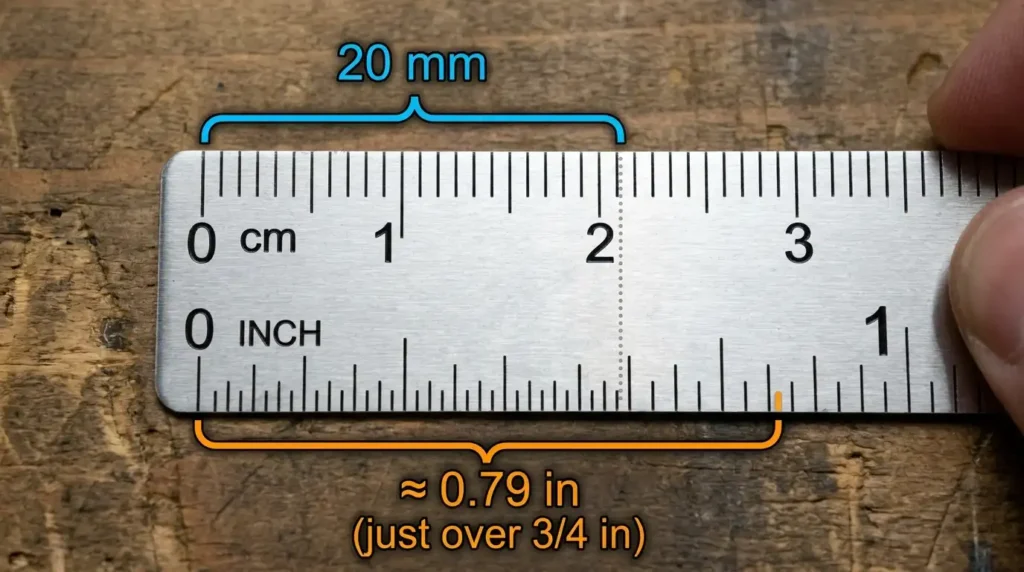
20 millimeters is equal to 0.7874 inches, or about 0.79 inches.
If you want to know how big 20 mm is in inches, it is a little less than one inch. It is also equal to 2 centimeters. You can picture this size by looking at a ruler or comparing it with things you use every day.
This guide explains the size of 20 mm in easy words. You will learn how to change millimeters into inches, how to find 20 mm on a ruler, and how this size compares with common items. You will also see a simple chart, useful examples, and answers to common questions.
How Many Inches Is 20 mm?
20 mm is equal to 0.7874 inches.
For normal use, you can round this number to 0.79 inches. You can also write it as about 25/32 of an inch.
Here is a quick look at the size:
- Millimeters: 20 mm
- Centimeters: 2 cm
- Inches: 0.7874 inches
- Rounded inches: 0.79 inches
- Approximate fraction: 25/32 inch
One inch is equal to 25.4 millimeters. This is the fixed value used when changing millimeters into inches.
Since 20 mm is less than 25.4 mm, it is also less than one inch. It is 5.4 mm shorter than one inch.
How to Change 20 mm Into Inches
You can change millimeters into inches by using a simple rule. Divide the number of millimeters by 25.4.
Formula:
Inches = Millimeters ÷ 25.4
Now use 20 mm in the formula:
20 ÷ 25.4 = 0.7874015748
So, the answer is:
20 mm = 0.7874 inches
You can round this answer to 0.79 inches if you only need a quick size guide.
Easy Steps to Find the Answer
Follow these steps:
- Start with 20 mm.
- Remember that 1 inch equals 25.4 mm.
- Divide 20 by 25.4.
- Your answer is 0.7874015748.
- Round it to 0.7874 inches.
This rule works for any millimeter size. Just divide the number by 25.4 to get the size in inches.
Is 20 mm Close to One Inch?
Yes. 20 mm is close to one inch, but it is not a full inch.
One inch is 25.4 mm. A 20 mm size is 5.4 mm shorter.
Here is a simple chart to show the difference:
| Size | Millimeters |
| 1/2 inch | 12.7 mm |
| 3/4 inch | 19.05 mm |
| 20 mm | 20 mm |
| 13/16 inch | 20.6375 mm |
| 1 inch | 25.4 mm |
As you can see, 20 mm is a little longer than 3/4 inch. It is also a little shorter than 13/16 inch.
This can help you picture the size when you look at a ruler that uses inches.
What Does 20 mm Look Like?
It can be hard to picture a size when you only see a number. A simple way to understand it is to compare it with other sizes.
A 20 mm length is:
- Equal to 2 centimeters.
- A little longer than 3/4 inch.
- A little shorter than 13/16 inch.
- About 0.79 inches.
- 5.4 mm shorter than one inch.
Think about a line that starts at zero and ends at the 20 mm mark on a metric ruler. That line is 2 centimeters long.
It is not as long as a full inch. However, it is close to that size.
Compare 20 mm With Common Things
You can understand 20 mm more easily by comparing it with things you may have seen or used.
1. A US Quarter Coin
<escape>A US quarter coin is about 24.26 mm wide across its face.</escape>
This means a quarter is wider than a 20 mm length. The difference is about 4.26 mm.
If you place a ruler across the face of a quarter, the distance from one side to the other is close to 24.26 mm. A 20 mm line is a little shorter.
This is a simple way to picture 20 mm because many people have seen or held a quarter.
Remember that this size is the width across the coin. It is not the thickness of the coin.
2. An AA Battery
An AA battery is about 14.5 mm wide across its round end. Its full length is about 50.5 mm.
A 20 mm size is wider than the round end of an AA battery. It is also much shorter than the full battery.
This shows why you should check which part of an item you are measuring. The width and length are not the same.
If you look at the round end of an AA battery, its width is less than 20 mm. If you look at the battery from top to bottom, it is much longer than 20 mm.
3. Three-Quarter Inch
Three-quarters of an inch is equal to 19.05 mm.
A 20 mm size is only 0.95 mm longer. This is a very small gap, so both sizes may look almost the same when you see them quickly.
But they are not exactly equal. If you are buying a part or checking whether something will fit, use the right size.
This is a useful way to picture 20 mm if you have an inch ruler.
4. A Two-Centimeter Line
20 mm is exactly 2 centimeters.
One centimeter has 10 millimeters. So, two centimeters have 20 millimeters.
You can see this size on a metric ruler. Find the zero mark and then look for the 2 cm mark.
The space between these two marks is exactly 20 mm.
This is one of the easiest ways to understand the size because you do not need to compare it with another item.
5. One Full Inch
One inch is 25.4 mm. A 20 mm size is 5.4 mm shorter.
You can find the difference with this simple sum:
25.4 − 20 = 5.4 mm
This means you need another 5.4 mm to make 20 mm equal to one inch.
20 mm in Inches and Centimeters
Millimeters, centimeters, and inches are all used to measure length. They show the same kind of size, but they use different units.
Millimeters and centimeters are part of the metric system. Inches are used in the inch-based measuring system.
Here is how 20 mm looks in each unit:
| Unit | Size |
| Millimeters | 20 mm |
| Centimeters | 2 cm |
| Inches | 0.7874 in |
| Rounded inches | 0.79 in |
| Approximate fraction | 25/32 in |
You can change millimeters into centimeters by dividing by 10.
20 ÷ 10 = 2 cm
To change millimeters into inches, divide by 25.4.
20 ÷ 25.4 = 0.7874 inches
Both rules are easy to use for other sizes too.
Quick Chart for 20 mm and Nearby Sizes
The chart below shows sizes from 15 mm to 25 mm. It can help you see how 20 mm compares with smaller and larger sizes.
| Millimeters | Centimeters | Inches |
| 15 mm | 1.5 cm | 0.5906 in |
| 16 mm | 1.6 cm | 0.6299 in |
| 17 mm | 1.7 cm | 0.6693 in |
| 18 mm | 1.8 cm | 0.7087 in |
| 19 mm | 1.9 cm | 0.7480 in |
| 20 mm | 2.0 cm | 0.7874 in |
| 21 mm | 2.1 cm | 0.8268 in |
| 22 mm | 2.2 cm | 0.8661 in |
| 23 mm | 2.3 cm | 0.9055 in |
| 24 mm | 2.4 cm | 0.9449 in |
| 25 mm | 2.5 cm | 0.9843 in |
The chart shows that 20 mm is close to 0.8 inches.
It also shows that 25 mm is close to one inch. However, 25 mm is still a little shorter than a full inch.
You can use this chart when you need to compare small sizes. It is also helpful when you want a quick answer without doing the sum again.

How to Find 20 mm on a Metric Ruler
A metric ruler is one of the easiest tools to use for this size.
Most metric rulers show centimeters and millimeters. Each centimeter has 10 small marks. Each small mark stands for 1 mm.
To find 20 mm:
- Place the ruler on a flat table.
- Find the zero mark.
- Count 20 small marks from zero.
- Stop at the 20 mm mark.
- Check that it is also at 2 cm.
The 20 mm mark and the 2 cm mark are at the same place.
If your ruler shows numbers in centimeters, you do not need to count all 20 small marks. Just find the number 2 on the ruler.
What Do the Small Marks Mean?
Some rulers have long marks for centimeters and short marks for millimeters.
The long mark at 1 cm means 10 mm. The long mark at 2 cm means 20 mm.
The small marks between these numbers help you measure sizes such as 11 mm, 12 mm, 13 mm, and more.
When you measure a small item, make sure its starting point is at zero. If you start from the wrong place, your answer may be wrong.
How to Find 20 mm on an Inch Ruler
An inch ruler may not show millimeters. It usually shows inches and small parts of an inch.
To find 20 mm on an inch ruler, first change the size into inches:
20 mm = 0.7874 inches
The closest common ruler mark, when using marks of 1/64 inch, is 25/32 inch.
This fraction equals 0.78125 inches. It is close to 20 mm, but it is not an exact match.
For a quick look, 25/32 inch is a useful guide. If you need the exact size, use 0.7874 inches or measure it with a metric ruler.
Common Marks on an Inch Ruler
An inch can be split into smaller parts. Common marks include:
- 1/2 inch
- 1/4 inch
- 1/8 inch
- 1/16 inch
- 1/32 inch
- 1/64 inch
These marks help you measure small sizes.
For example, 3/4 inch is equal to 0.75 inches. This is a little shorter than 20 mm, which is about 0.7874 inches.
The mark for 25/32 inch is closer to 20 mm than the mark for 3/4 inch.
Is 20 mm Bigger Than 3/4 Inch?
Yes. 20 mm is a little bigger than 3/4 inch.
Three-quarters of an inch is equal to 19.05 mm.
To find the gap, subtract 19.05 from 20:
20 − 19.05 = 0.95 mm
So, 20 mm is 0.95 mm longer than 3/4 inch.
The gap is less than 1 mm. This means both sizes may look very close when you see them without a ruler.
But they are not the same. If you are cutting wood, buying a part, or checking a space, use the right size.
Is 20 mm Bigger Than 13/16 Inch?
No. 20 mm is a little smaller than 13/16 inch.
13/16 inch is equal to 0.8125 inches.
To change this size into millimeters, multiply it by 25.4:
0.8125 × 25.4 = 20.6375 mm
So, 13/16 inch is 20.6375 mm. This is a little longer than 20 mm.
The gap is:
20.6375 − 20 = 0.6375 mm
This is a small gap, but it can matter when you need a close fit.
Is 20 mm the Same as 2 cm?
Yes. 20 mm is exactly equal to 2 cm.
There are 10 millimeters in one centimeter.
To change 20 mm into centimeters, divide by 10:
20 ÷ 10 = 2 cm
There is no rounding in this answer. It is exactly 2 cm.
Many rulers show both centimeters and millimeters. If you cannot find the 20 mm mark, look for the 2 cm mark instead.
Why Do People Change 20 mm Into Inches?
People change millimeters into inches for many daily tasks. Some rulers use millimeters, while others use inches.
Knowing both units helps you read size details, use a ruler, and compare items.
Here are some common reasons for changing 20 mm into inches.
1. Measuring Small Items
You may need to measure a small item that has its size written in millimeters.
If your ruler uses inches, you can change the size to inches to understand it better.
For example, if a small item is 20 mm wide, you now know that it is about 0.79 inches wide.
This helps you compare it with other items that are measured in inches.
2. Home Projects
People often use different measuring tools when working at home.
A guide may show a size in millimeters, while your ruler or tape measure may use inches.
If a piece needs to be 20 mm long or wide, knowing that it is about 0.79 inches can help you picture the size.
For work that needs a close fit, use the exact size instead of only using the rounded number.
3. Buying Small Parts
Some small parts are sold with sizes written in millimeters.
If you are used to inches, the size may not be easy to picture.
Changing 20 mm into 0.79 inches gives you a better idea of how big the part is.
Always check the full size details. A number may show the length, width, height, or thickness of an item.
4. Reading Product Details
Product pages and guides may show sizes in millimeters. This is common when products are sold in many countries.
You may see a size of 20 mm and want to know what it means in inches.
The answer is simple: 20 mm is about 0.79 inches.
This helps you compare items even when they use different units.
5. School Work
Students often learn how to change metric sizes into inches.
The 20 mm example is easy to follow because it is also equal to 2 cm.
It also gives an answer that is less than one inch.
By using this example, students can learn how to divide a number to change it from millimeters into inches.
How Exact Is 20 mm = 0.79 Inches?
The answer 0.79 inches is rounded. It is good for a quick size guide, but it is not the full answer.
The more exact value is:
20 mm = 0.7874015748 inches
When you round it to four decimal places, it becomes 0.7874 inches.
When you round it to two decimal places, it becomes 0.79 inches.
The rounded number is a little higher than the full value. This happens because the next number after 0.78 is high enough to round it up to 0.79.
For many daily tasks, this small change does not matter. But it may matter when two parts need to fit together.
Which Number Should You Use?
Use the number that best fits your task:
| Reason | Number to Use |
| Quick answer | 0.79 inches |
| More exact answer | 0.7874 inches |
| Fraction estimate | About 25/32 inch |
| Metric size | 20 mm |
| Size in centimeters | 2 cm |
If you only want to picture the size, 0.79 inches is fine.
If you are working with a part that needs to fit well, use 20 mm or 0.7874 inches. Do not use a rounded fraction when you need a very close size.
Common Mistakes When Changing 20 mm Into Inches
Changing millimeters into inches is easy, but some small mistakes can give you the wrong answer.
Mistake 1: Dividing by 10
Dividing by 10 changes millimeters into centimeters. It does not change them into inches.
For example:
20 ÷ 10 = 2 cm
This answer is right in centimeters, but it is not the answer in inches.
To get inches, use this sum:
20 ÷ 25.4 = 0.7874 inches
Mistake 2: Multiplying Instead of Dividing
To change millimeters into inches, divide by 25.4.
Do not multiply 20 by 25.4. That would give the wrong answer.
The right rule is:
Inches = Millimeters ÷ 25.4
Mistake 3: Saying 20 mm Is One Inch
One inch is equal to 25.4 mm, not 20 mm.
20 mm is about 0.79 inches. It is 5.4 mm shorter than one inch.
Mistake 4: Saying 25/32 Inch Is Exact
20 mm is close to 25/32 inch, but the two sizes are not exactly the same.
25/32 inch is 0.78125 inches. 20 mm is about 0.7874 inches.
Use the decimal answer when you need a closer value.

Mistake 5: Mixing Up Length and Width
When you compare 20 mm with an item, check which part of the item you are measuring.
For example, the width of a coin is measured across its face. Its thickness is a different size.
The same rule applies to batteries, tools, and other items. Always compare the same part of each item.
Easy Tips for Measuring 20 mm
A correct answer is useful, but you also need to measure the item in the right way.
Use these simple tips:
- Put the ruler on a flat table.
- Start from the zero mark.
- Keep the item straight along the ruler.
- Look directly at the mark you are reading.
- Check if the ruler uses millimeters, centimeters, or inches.
- Do not guess between two marks.
- Use a better measuring tool if you need a very close answer.
If you use a metric ruler, look for the 2 cm mark. If you use an inch ruler, remember that 20 mm is about 0.79 inches.
For small parts, a digital caliper can help you measure more closely than a normal ruler. Make sure you use the right part of the tool for the size you want to check.
When Should You Use Millimeters Instead of Inches?
Millimeters are useful when you measure small items. They let you write a small size as a whole number.
For example, 20 mm is easy to read and write. The same size in inches is about 0.7874 inches.
Both numbers show the same length. But millimeters may be easier to use for some small items.
Millimeters are used in many product details, drawings, and small-part sizes. Inches are also used in many places, especially where inch-based rulers and tools are common.
You do not have to use only one type of unit. Use the one that matches your ruler, guide, or work.
If the guide gives a size in millimeters, it is often best to keep using millimeters when you measure. Only change the size into inches when you need to compare it with an inch ruler or another size written in inches.
Easy Way to Remember the Size of 20 mm
You can remember 20 mm by keeping these three facts in mind:
- 20 mm is equal to 2 cm.
- 20 mm is about 0.79 inches.
- 20 mm is a little longer than 3/4 inch.
These facts make the size easy to picture without doing the sum each time.
You can also remember that one inch is 25.4 mm. Since 20 mm is less than 25.4 mm, it must be less than one inch.
For a quick answer, think of 20 mm as just under 0.8 inches.
Frequently Asked Questions
1. How many inches is 20 mm?
20 mm is equal to 0.7874015748 inches. Rounded to four decimal places, it is 0.7874 inches. For daily use, you can round it to 0.79 inches.
2. Is 20 mm bigger than 3/4 inch?
Yes. Three-quarters of an inch is equal to 19.05 mm. A 20 mm size is 0.95 mm longer.
3. How many centimeters are in 20 mm?
20 mm is equal to exactly 2 cm. There are 10 millimeters in one centimeter, so divide 20 by 10 to get 2.
4. What is 20 mm as a fraction of an inch?
20 mm is about 25/32 inch when rounded to the nearest 1/64-inch mark. This is close, but it is not exact. The decimal value of 0.7874 inches gives a closer answer.
Conclusion
20 mm is equal to 0.7874 inches, or about 0.79 inches. It is also exactly 2 centimeters. This size is a little longer than 3/4 inch and shorter than one full inch. You can find it on a metric ruler by looking for the 2 cm mark. To change any millimeter size into inches, divide it by 25.4. Use 0.79 inches for a quick answer and 0.7874 inches when you need a closer value.

Chloe Harper writes clear, practical guides on measurements and unit conversions. She focuses on simple explanations and real-life examples so readers can get accurate answers quickly.