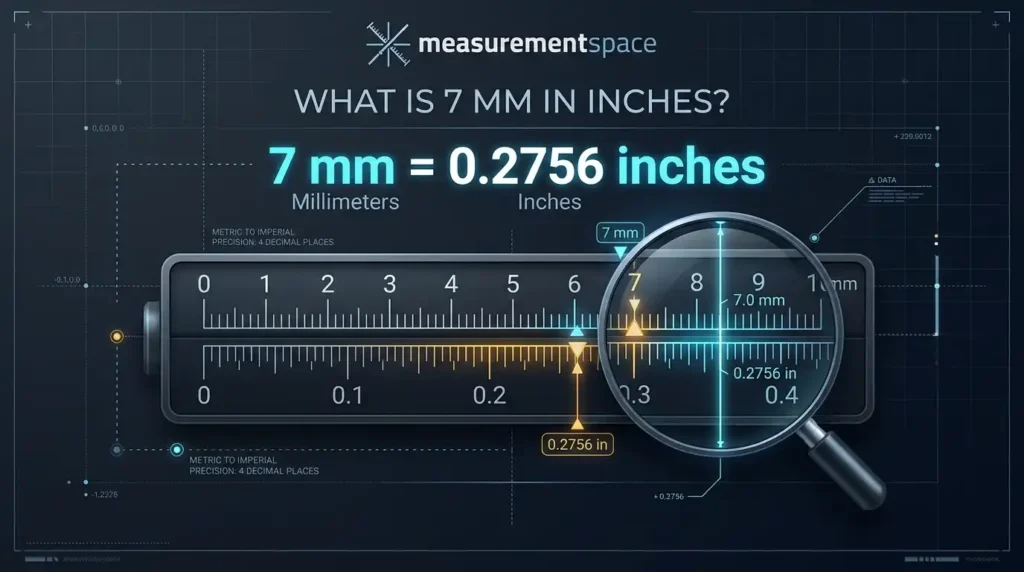
7 mm is equal to 0.2756 inches. This means 7 millimeters is a little more than one-quarter of an inch. It is a small size often used to measure the width, length, or thickness of small items.
To change 7 mm into inches, divide 7 by 25.4. The answer is 0.2755905 inches. When rounded to four decimal places, it becomes 0.2756 inches.
In this guide, you will learn how to change 7 mm into inches. You will also see the simple formula, a size chart, and easy examples. The guide will help you understand this measurement and use it in daily work.
Quick Answer: 7 mm to Inches
The answer is:
7 mm = 0.2756 inches
Here are the main details:
- Millimeters: 7 mm
- Inches: 0.2755905 inches
- Rounded answer: 0.2756 inches
- Closest common fraction: About 9/32 inch
- Formula: 7 ÷ 25.4
The decimal answer is useful when you need a clear number. The fraction can help when you are using a ruler that shows inch marks.
How Much Is 7 mm in Inches?
Seven millimeters is about 0.2756 inches. It is a little more than one-quarter of an inch.
One inch has 25.4 millimeters. This means that 7 mm is much less than one full inch.
You can compare 7 mm with one-quarter of an inch. One-quarter of an inch is 0.25 inches. Seven millimeters is a little larger than this.
The difference may look small, but it can matter when you need the right size. For example, if you are measuring a small part, 0.2756 inches gives you a better answer than simply saying one-quarter of an inch.
A 7 mm size may be used for small tools, plastic parts, metal pieces, and craft items. The use depends on the item you are measuring.
How to Change 7 mm into Inches
You can change millimeters into inches by using a simple formula.
The formula is:
Inches = Millimeters ÷ 25.4
To change 7 mm into inches, put 7 in place of millimeters.
7 ÷ 25.4 = 0.2755905
The answer is about 0.2756 inches.
You can use this same rule for any millimeter value.
Step-by-Step Calculation
Follow these easy steps to change 7 mm into inches.
Step 1: Write the given size
Start with the number:
7 mm
Step 2: Use the correct number
One inch is equal to 25.4 millimeters.
Step 3: Divide the number
Now divide 7 by 25.4:
7 ÷ 25.4 = 0.2755905
Step 4: Round the answer
Round the number to four decimal places:
0.2756 inches
So, the final answer is:
7 mm = 0.2756 inches
This method is easy to use for both small and large sizes.
Why Do We Divide by 25.4?
We use 25.4 because one inch is exactly equal to 25.4 millimeters.
Millimeters and inches are two different units used to measure length. Millimeters are part of the metric system. Inches are used in the measuring system common in the United States.
An inch is longer than a millimeter. So, when changing millimeters into inches, you divide the millimeter value by 25.4.
For example:
- 25.4 mm = 1 inch
- 12.7 mm = 0.5 inches
- 6.35 mm = 0.25 inches
- 7 mm = 0.2756 inches
This rule makes the work easy. You do not need a new formula for every size.
Is 7 mm More or Less Than 1/4 Inch?
Seven millimeters is a little more than one-quarter of an inch.
One-quarter of an inch is equal to 0.25 inches. Seven millimeters is about 0.2756 inches.
Here is the difference:
- 7 mm = 0.2756 inches
- 1/4 inch = 0.25 inches
The difference is about 0.0256 inches.
This means 7 mm is larger than 1/4 inch, but the two sizes are close.
If you look at a ruler, 7 mm is near the one-quarter-inch mark. However, the two marks do not show the exact same size.
For a quick idea of the size, one-quarter of an inch may help. If you need the correct value, use 0.2756 inches.
7 mm as a Fraction of an Inch
Some rulers show fractions instead of decimal numbers. Common examples are 1/4, 1/8, 1/16, and 1/32 inch.
The decimal value of 7 mm is:
0.2755905 inches
The closest common fraction, using marks in steps of 1/64 inch, is 9/32 inch.
Here is the comparison:
- 7 mm = 0.2755905 inches
- 9/32 inch = 0.28125 inches
These two sizes are close, but they are not exactly the same.
The difference is about 0.00566 inches. This small gap may matter when two parts need to fit together.
Remember that 9/32 inch is only a close match for 7 mm. If you need the correct size, use 7 mm. If you need the decimal inch value, use 0.2756 inches.
7 mm to Inches Conversion Chart
A size chart helps you compare millimeters with inches. It also saves time because you do not need to work out every number yourself.
The chart below shows sizes from 1 mm to 10 mm.
| Millimeters (mm) | Inches |
| 1 mm | 0.0394 in |
| 2 mm | 0.0787 in |
| 3 mm | 0.1181 in |
| 4 mm | 0.1575 in |
| 5 mm | 0.1969 in |
| 6 mm | 0.2362 in |
| 7 mm | 0.2756 in |
| 8 mm | 0.3150 in |
| 9 mm | 0.3543 in |
| 10 mm | 0.3937 in |
All values are rounded to four decimal places.
The chart makes it easy to find the inch value for each size. You can also compare 7 mm with the sizes near it.
For example, 6 mm is about 0.2362 inches, while 8 mm is about 0.3150 inches. This shows that 7 mm is between these two sizes.
How to Measure 7 mm with a Ruler
You can measure 7 mm with a ruler that has millimeter marks.
Most metric rulers show centimeters and millimeters. One centimeter has 10 millimeters.
Follow these steps to find 7 mm:
- Place the ruler next to the item.
- Find the zero mark.
- Look at the small lines after zero.
- Count seven small lines.
- The seventh line shows 7 mm.
If your ruler only shows inches, you can use 0.2756 inches as a guide.
An inch ruler may not have a mark for exactly 0.2756 inches. If you need a closer answer, use a ruler with millimeter marks or a digital measuring tool.
Make sure the ruler starts at the edge of the item. If it does not start at zero, your answer may be wrong.
What Does 7 mm Look Like?
Seven millimeters is a small size. It is less than one centimeter because one centimeter is equal to 10 millimeters.
You can use these facts to understand its size:
- 7 mm is 0.7 cm.
- 7 mm is about 0.2756 inches.
- 7 mm is a little more than 1/4 inch.
- 7 mm is less than 1 cm.
These facts help you picture the size without using a measuring tool.
However, it can be hard to know the exact size of an item just by looking at it. Two items may look close in size but have different measurements.
If you need to know whether something is exactly 7 mm, use a ruler or measuring tool instead of guessing.
Where Is a 7 mm Measurement Used?
A 7 mm measurement can be used in many types of work. It may show the width, thickness, height, or length of a small item.
The meaning depends on what you are measuring.
1. Tools and Small Parts
Small tools and machine parts are often measured in millimeters. A part with a 7 mm size may need to fit into another part.
When using tools, it is important to check the right size first. A part that is too big or too small may not fit.
The change from 7 mm to 0.2756 inches can help people who use inch-based tools understand the size.
2. Woodwork
People who work with wood may use millimeters to measure small pieces, gaps, or the thickness of wood.
For example, someone may need to compare a 7 mm size with a ruler that shows inches. The value of 0.2756 inches makes this easier.
The right size is important when cutting or joining wood. Even a small change can affect how two pieces fit together.
3. Metalwork
Metal parts are often measured in millimeters. A 7 mm size may show the width or thickness of a small metal piece.
Workers may need to change this number into inches when using tools or plans that show inch sizes.
In this case, 0.2756 inches is more accurate than using the rough value of 1/4 inch.
4. Plastic Items
Plastic parts may also be measured in millimeters.
A 7 mm size could show the width, height, or thickness of a small plastic part. The exact meaning depends on the item.
If a product guide uses inches, changing 7 mm into 0.2756 inches makes the size easier to understand.

5. Craft and DIY Work
People who enjoy craft work may use millimeters when cutting or joining small items.
For example, a craft plan may ask for a part that is 7 mm wide. If the guide uses inches, the change helps you follow the right size.
For simple craft work, a close fraction may be enough. If the parts need to fit closely, use the decimal value.
6. Product Sizes
Online shops may show product sizes in millimeters, while other shops use inches.
Knowing that 7 mm is equal to 0.2756 inches can help you compare products.
This is useful when checking small parts, tools, and other items. Always check whether the number shows the length, width, height, or thickness of the item.
Common Mistakes When Changing 7 mm into Inches
Changing millimeters into inches is easy, but some mistakes can give you the wrong answer.
Here are a few mistakes to avoid.
Mistake 1: Multiplying Instead of Dividing
To change millimeters into inches, divide by 25.4.
The correct calculation is:
7 ÷ 25.4 = 0.2755905
If you multiply 7 by 25.4, you will get the wrong answer for this change.
Mistake 2: Using 25 Instead of 25.4
Some people use 25 as a quick way to work out the answer. It may give a close value, but it is not the correct number.
Using 25 gives:
7 ÷ 25 = 0.28
The correct answer is about 0.2756 inches.
The difference may look small, but it can matter when you need the right size.
Mistake 3: Rounding Too Soon
Rounding a number too early can change the final answer.
For example, the full answer is 0.2755905 inches. If you round it to 0.28 before using it in another sum, your final answer may be less accurate.
It is better to keep the full number while working and round only at the end.
Mistake 4: Saying 1/4 Inch Is the Exact Same Size
One-quarter of an inch is 0.25 inches. Seven millimeters is about 0.2756 inches.
These sizes are close, but they are not equal.
If you use 1/4 inch instead of 7 mm, you will be using a smaller size.
Mistake 5: Mixing Up Millimeters and Centimeters
A millimeter and a centimeter are not the same unit.
There are 10 millimeters in one centimeter. So, 7 mm is equal to 0.7 cm, not 7 cm.
Always check the unit before you start the sum.
Easy Way to Change Other Millimeter Sizes into Inches
Once you know how to change 7 mm into inches, you can use the same formula for other sizes.
Use this formula:
Inches = Millimeters ÷ 25.4
Here are some easy examples.
Example 1: Change 5 mm into inches
5 ÷ 25.4 = 0.1968504
Rounded answer: 0.1969 inches.
Example 2: Change 10 mm into inches
10 ÷ 25.4 = 0.3937008
Rounded answer: 0.3937 inches.
Example 3: Change 15 mm into inches
15 ÷ 25.4 = 0.5905512
Rounded answer: 0.5906 inches.
Example 4: Change 20 mm into inches
20 ÷ 25.4 = 0.7874016
Rounded answer: 0.7874 inches.
These examples show that the same formula works for every millimeter size.
Millimeters and Inches: What Is the Difference?
Millimeters and inches are both used to measure length. The main difference is that they belong to two different measuring systems.
A millimeter is part of the metric system. This system is used in many countries around the world.
An inch is part of the measuring system used in countries such as the United States. Inches are also used in some tools, product guides, and building plans in other countries.
Here are some basic facts:
- 1 inch = 25.4 mm
- 1 mm = 0.03937 inches
- 10 mm = 1 cm
- 100 cm = 1 meter
- 12 inches = 1 foot
The metric system uses groups of 10, which makes many changes easy. The inch system uses other steps, such as 12 inches in one foot.
Knowing both systems can help you understand sizes in books, product guides, building plans, and daily work.
When Should You Use Decimal Inches or Fractions?
You can write 7 mm in inches as a decimal or as a close fraction.
The best choice depends on the work you are doing.
Use Decimal Inches for a Clear Number
The decimal value is:
0.2756 inches
This is a good choice when you need a clear number. It is also useful with calculators and digital measuring tools.
Use Fractions with an Inch Ruler
The closest common fraction using 1/64-inch steps is:
9/32 inch
This is close to 7 mm, but it is not exactly the same size.
Fractions are often easy to read on rulers that show marks such as 1/2, 1/4, 1/8, and 1/16 inch.
Which One Is Better?
For a more exact change into inches, use 0.2756 inches.
For a quick look at an inch ruler, 9/32 inch may help. Remember that it is only a close match.
If a part needs to fit in another part, do not replace the 7 mm size with a close fraction. Use the original size when possible.

Quick Guide: 7 mm Measurement Details
Here is a short list of the main values:
| Measurement | Value |
| Millimeters | 7 mm |
| Centimeters | 0.7 cm |
| Inches | 0.2755905 in |
| Rounded inches | 0.2756 in |
| Closest 1/64-inch fraction | 9/32 in |
| One-quarter inch | 0.25 in |
| One centimeter | 10 mm |
This table puts the main size changes in one place.
Frequently Asked Questions
1. What is 7 mm in inches?
7 mm is equal to 0.2755905 inches. When rounded to four decimal places, it is 0.2756 inches.
To get this answer, divide 7 by 25.4.
2. Is 7 mm the same as 1/4 inch?
No. Seven millimeters is a little larger than 1/4 inch.
Seven millimeters is about 0.2756 inches, while 1/4 inch is 0.25 inches. The two sizes are close, but they are not the same.
3. What is 7 mm as a fraction of an inch?
The closest common fraction to 7 mm, using 1/64-inch steps, is 9/32 inch.
This is a close match, not an exact one. The decimal answer, 0.2756 inches, gives a closer value.
4. How many centimeters are in 7 mm?
Seven millimeters is equal to 0.7 centimeters.
To change millimeters into centimeters, divide by 10.
7 ÷ 10 = 0.7 cm.
5. How do I change millimeters into inches?
Divide the millimeter value by 25.4.
For example:
7 ÷ 25.4 = 0.2755905 inches.
You can use this formula for any millimeter size.
6. Is 7 mm close to 0.3 inches?
Yes. Seven millimeters is about 0.2756 inches, which is close to 0.3 inches.
However, 0.3 inches is a little larger. If you need the correct value, use 0.2756 inches.
7. Is 7 mm smaller than 1 inch?
Yes. Seven millimeters is much smaller than one inch.
One inch is equal to 25.4 millimeters. Seven millimeters is only about 0.2756 inches.
8. How can I measure 7 mm without a digital tool?
You can use a ruler with millimeter marks. Find the zero mark and count seven small lines.
If you only have an inch ruler, you can use 0.2756 inches as a guide. A ruler with millimeter marks will make this size easier to find.
Conclusion
Seven millimeters is equal to 0.2756 inches when rounded to four decimal places. You can find this answer by dividing 7 by 25.4. It is a little more than 1/4 inch, and its closest common 1/64-inch fraction is about 9/32 inch.
Use the decimal value when you need a clear and close answer. Use the fraction only as a guide for an inch ruler. You can also use the same formula to change any other millimeter size into inches.

Chloe Harper writes clear, practical guides on measurements and unit conversions. She focuses on simple explanations and real-life examples so readers can get accurate answers quickly.