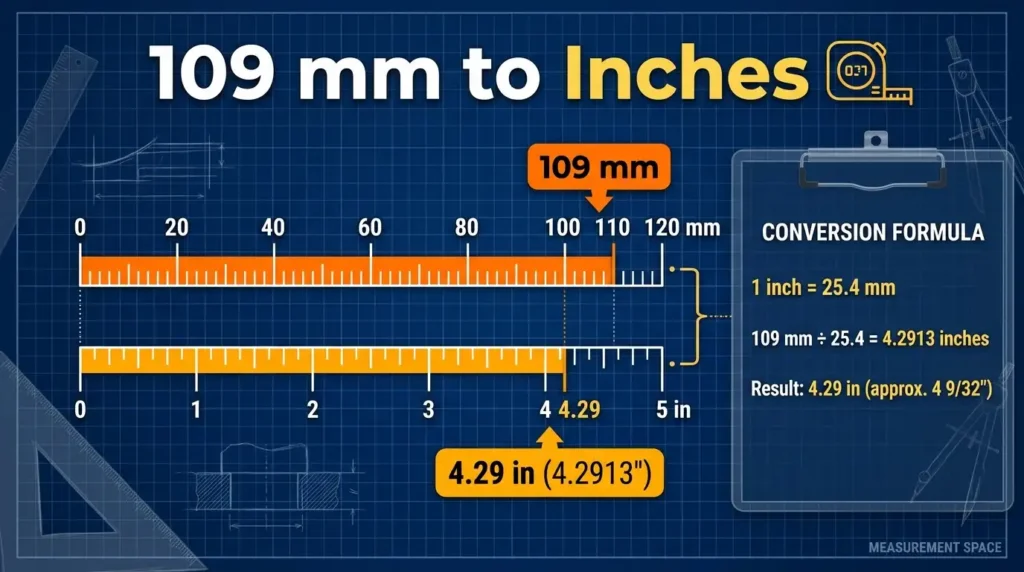
109 mm is equal to 4.2913 inches. Rounded to two decimal places, it is 4.29 inches. As a fraction, 109 mm is approximately 4 19/64 inches.
If you need to change a measurement from millimeters to inches, the calculation is simple. Divide the number of millimeters by 25.4. This gives you the inch value.
For 109 mm, the calculation is:
109 ÷ 25.4 = 4.29133858 inches
The exact result is a repeating decimal, so the value is usually written as 4.2913 inches. You can use this conversion when measuring objects, checking product sizes, working on home projects, or comparing metric and inch measurements.
How to Convert 109 mm to Inches
To convert 109 mm to inches, divide 109 by 25.4. This works because one inch is exactly equal to 25.4 millimeters.
The conversion formula is:
Inches = Millimeters ÷ 25.4
Now put 109 into the formula:
Inches = 109 ÷ 25.4
Inches = 4.29133858
Therefore:
109 mm = 4.2913 inches
You can also write this result as 4.29 inches when you only need two decimal places.
Why Do You Divide by 25.4?
Millimeters and inches are two different units used to measure length. A millimeter is part of the metric system, while an inch is part of the imperial measurement system.
One inch contains 25.4 millimeters. This means an inch is larger than a millimeter.
When you change a smaller unit into a larger unit, the number becomes smaller. That is why you divide the millimeter value by 25.4.
For example:
- 25.4 mm = 1 inch
- 50.8 mm = 2 inches
- 76.2 mm = 3 inches
- 101.6 mm = 4 inches
The same rule works for 109 mm. Since 109 mm is a little more than 101.6 mm, its inch value is a little more than 4 inches.
Step-by-Step Calculation
You can follow these steps whenever you need to convert 109 mm into inches.
Step 1: Write the measurement.
Start with the given value:
109 mm
Step 2: Write the conversion number.
Remember that:
1 inch = 25.4 mm
Step 3: Divide the millimeter value.
109 ÷ 25.4 = 4.29133858
Step 4: Round the answer.
The result is approximately 4.2913 inches.
If you need a shorter answer, round it to 4.29 inches.
This method is useful for both small and large measurements. You only need to change the number of millimeters and divide it by the same value.
109 mm in Inches as a Fraction
Some people prefer to use fractions instead of decimal numbers when measuring. Fractions are common on rulers, measuring tapes, and many tools.
The decimal result for 109 mm is 4.29133858 inches. When rounded to the nearest 1/64 inch, it is approximately:
109 mm ≈ 4 19/64 inches
This is an approximate fraction, not an exact conversion.
How to Find the Fraction
First, separate the whole number from the decimal part.
4.29133858 = 4 + 0.29133858
Next, multiply the decimal part by 64:
0.29133858 × 64 = 18.64566912
Round 18.64566912 to the nearest whole number. The result is 19.
This gives the fraction 19/64.
The final measurement is:
4 19/64 inches
This fraction is useful when working with a ruler that has 64 small divisions in each inch. If your ruler only shows eighths or sixteenths, you may need to use the closest mark available.
Quick Conversion Chart
The following chart shows 109 mm and other nearby millimeter values in inches. It can help you compare measurements without doing each calculation yourself.
| Millimeters (mm) | Inches (decimal) | Approximate fraction |
| 90 mm | 3.5433 in | 3 35/64 in |
| 95 mm | 3.7402 in | 3 47/64 in |
| 100 mm | 3.9370 in | 3 15/16 in |
| 105 mm | 4.1339 in | 4 9/64 in |
| 109 mm | 4.2913 in | 4 19/64 in |
| 110 mm | 4.3307 in | 4 21/64 in |
| 115 mm | 4.5276 in | 4 17/32 in |
| 120 mm | 4.7244 in | 4 23/32 in |
| 125 mm | 4.9213 in | 4 59/64 in |
| 130 mm | 5.1181 in | 5 8/64 in |
The decimal values are rounded to four places. The fractions are rounded to the nearest 1/64 inch. Some fractions can be reduced to simpler forms. For example, 5 8/64 inches is the same as 5 1/8 inches.
How to Read the Chart
The first column gives the measurement in millimeters. The second column shows the same length in decimal inches. The third column gives an approximate fraction.
For example, if you want to know the inch value of 110 mm, look at the row for 110 mm. It is equal to about 4.3307 inches.
The row for 109 mm gives the main answer: 4.2913 inches.
You can use the chart to compare nearby sizes. A difference of 1 mm may look small, but it still changes the final measurement. For accurate work, use the decimal value rather than choosing a nearby row.
Understanding Millimeters and Inches
Millimeters and inches both measure length. However, they belong to different measurement systems.
Knowing the difference between these units can help you understand why conversion is needed.
What Is a Millimeter?
A millimeter is a small unit of length in the metric system. It is written as mm.
There are 1,000 millimeters in one meter. There are also 10 millimeters in one centimeter.
Millimeters are useful for measuring small objects and details. For example, they can be used to measure the thickness of a sheet, the width of a small part, or the size of a screw.
The metric system uses steps of ten. This makes it easy to change between millimeters, centimeters, and meters.
What Is an Inch?
An inch is a unit of length used in the imperial and US customary measurement systems. It is written as in or sometimes shown with the symbol “.
There are 12 inches in one foot. There are 36 inches in one yard.
Inches are often used for measuring screens, furniture, building materials, tools, and many household items.
For example, a screen may be sold using its diagonal size in inches. A ruler may also show inches along one edge.

How Are the Two Units Related?
The main relationship is simple:
1 inch = 25.4 millimeters
You can use this value to convert measurements in either direction.
To change millimeters into inches, divide by 25.4.
To change inches into millimeters, multiply by 25.4.
For example:
- 25.4 mm = 1 inch
- 50.8 mm = 2 inches
- 76.2 mm = 3 inches
- 101.6 mm = 4 inches
- 127 mm = 5 inches
These examples show how the two units are connected.
Where Is a 109 mm Measurement Useful?
A length of 109 mm may appear in many everyday measuring tasks. The exact use depends on the object being measured.
Here are some situations where converting 109 mm into inches can help.
1. Home Improvement Projects
Home improvement work often involves measurements from different systems. A plan may show a length in millimeters, while a ruler or tool may use inches.
Converting 109 mm to 4.2913 inches helps you understand the size in the unit you are using.
For example, you may need to check the length of a small wood piece, a plastic part, or a space between two surfaces.
Before cutting or fitting any material, check the measurement with a suitable ruler or measuring tool. Do not rely only on a rounded value when a close fit is important.
2. DIY and Craft Work
Craft projects may involve paper, wood, plastic, fabric, or other materials. Some instructions use millimeters, while others use inches.
If a project asks for a length of 109 mm, converting it to 4.2913 inches can make the instruction easier to follow when your ruler uses inches.
You can use the decimal value for a digital measuring tool. If you are using a ruler with fraction marks, the approximate value is 4 19/64 inches.
Keep in mind that not every ruler has 64 marks between each inch. Use the smallest clear marking available on your tool.
3. Product Measurements
Online product descriptions may show measurements in millimeters or inches. This can make it difficult to compare two products.
For example, one product may list a part as 109 mm long, while another may show a similar measurement in inches.
Changing 109 mm to 4.29 inches helps you compare the numbers more easily.
However, always check the full size information. Length, width, height, and thickness are different measurements. A single converted value does not describe the complete size of an object.
4. Small Parts and Materials
Small parts may be measured in millimeters because the unit makes it easier to show small differences.
If you need to read the same measurement in inches, use the conversion formula.
For example, a part listed as 109 mm has a length of approximately 4.2913 inches. This can help when reading instructions or comparing measurements from two sources.
For work that needs a close fit, use the original measurement and a tool with suitable accuracy.
How to Measure 109 mm on a Ruler
You can use a ruler to check a length of 109 mm. The method depends on whether your ruler shows millimeters, centimeters, or inches.
Using a Metric Ruler
A metric ruler usually shows centimeters and millimeters.
There are 10 millimeters in each centimeter. To find 109 mm, count 10 full centimeters and then 9 more millimeters.
This is because:
100 mm + 9 mm = 109 mm
So, 109 mm is the same as 10.9 cm.
Using an Inch Ruler
If your ruler only shows inches, use the converted value.
109 mm is approximately 4.2913 inches.
This means the length is a little more than 4 and 1/4 inches. The exact fraction rounded to the nearest 1/64 inch is about 4 19/64 inches.
A ruler with 64 divisions per inch can show this fraction more closely. A ruler with fewer divisions may not show the exact mark.
Choosing the Right Measuring Tool
Use a metric ruler when the original measurement is in millimeters. Use an inch ruler when the instructions or parts are marked in inches.
A digital caliper may be helpful when measuring small parts that need greater accuracy. Always check that the tool is set to the correct unit before reading the result.
Common Measurement Mistakes
Converting measurements is easy, but a few mistakes can lead to the wrong result. Keep these points in mind when changing 109 mm to inches.
1. Multiplying Instead of Dividing
The most common mistake is using the wrong operation.
To convert millimeters to inches, divide by 25.4.
To convert inches to millimeters, multiply by 25.4.
For 109 mm, the correct calculation is:
109 ÷ 25.4 = 4.2913 inches
Do not multiply 109 by 25.4 for this conversion.
2. Mixing Up Millimeters and Centimeters
A centimeter is larger than a millimeter. There are 10 millimeters in one centimeter.
This means 109 mm is equal to 10.9 cm, not 109 cm.
Always check the unit before doing the calculation. A mistake between millimeters and centimeters can make the result ten times too large or too small.
3. Rounding Too Early
The full result for 109 mm is 4.29133858 inches.
If you round it to 4.29 inches, the result is easier to read, but it loses a small amount of detail.
For simple comparisons, 4.29 inches is usually clear. For more careful measuring work, keep the longer value until the final step.
4. Treating an Approximate Fraction as Exact
The fraction 4 19/64 inches is close to the decimal result, but it is not exactly equal to 109 mm.
Fractions on a ruler depend on the number of divisions shown. A ruler with sixteenths may not show a mark for 19/64.
Use the decimal result when you need more detail than the ruler’s fraction marks can provide.
5. Forgetting to Include the Unit
A number without a unit can cause confusion.
For example, 4.2913 could mean inches, centimeters, or another unit depending on the situation.
Write the complete result as 4.2913 inches. This makes the measurement clear.

How to Convert Other Millimeter Measurements to Inches
The same formula works for any millimeter value. You do not need a different method for each measurement.
Use this formula:
Inches = Millimeters ÷ 25.4
For example, if you want to convert 80 mm into inches:
80 ÷ 25.4 = 3.1496 inches
If you want to convert 150 mm:
150 ÷ 25.4 = 5.9055 inches
If you want to convert 200 mm:
200 ÷ 25.4 = 7.8740 inches
These examples use the same calculation as 109 mm. Only the starting number changes.
Can You Convert Millimeters Without a Calculator?
Yes. You can use a conversion chart or remember a few common values.
For example, 25.4 mm equals 1 inch, and 50.8 mm equals 2 inches. These values can help you make a quick estimate.
For a more accurate result, use a calculator and divide the millimeter measurement by 25.4.
A mental estimate can be useful when you only need a general idea of the size. It should not replace an accurate measurement when a project needs a close fit.
FAQs
1. How many inches is 109 mm?
109 mm is equal to approximately 4.2913 inches. Rounded to two decimal places, it is 4.29 inches.
2. What is 109 mm in inches as a fraction?
109 mm is approximately 4 19/64 inches when rounded to the nearest 1/64 inch. This fraction is not an exact value.
3. Is 109 mm more than 4 inches?
Yes. Four inches is equal to 101.6 mm. Since 109 mm is greater than 101.6 mm, it is more than 4 inches.
4. How many centimeters are in 109 mm?
There are 10 millimeters in one centimeter. Divide 109 by 10 to get 10.9 cm.
5. How do I convert 109 mm back to millimeters?
If you start with 4.29133858 inches, multiply by 25.4 to return to millimeters.
4.29133858 × 25.4 is approximately 109 mm.
6. What is the easiest way to convert millimeters to inches?
Divide the millimeter value by 25.4. This gives the measurement in inches. For 109 mm, the answer is 4.2913 inches.
Conclusion
109 mm is equal to 4.2913 inches, or about 4.29 inches when rounded to two decimal places. Its nearest 1/64-inch fraction is approximately 4 19/64 inches.
To make this conversion, divide 109 by 25.4. You can use the same formula for any millimeter measurement. It is helpful when reading product sizes, following project plans, comparing materials, and working with rulers that use inches.

Chloe Harper writes clear, practical guides on measurements and unit conversions. She focuses on simple explanations and real-life examples so readers can get accurate answers quickly.