What Is 30 mm in Inches?
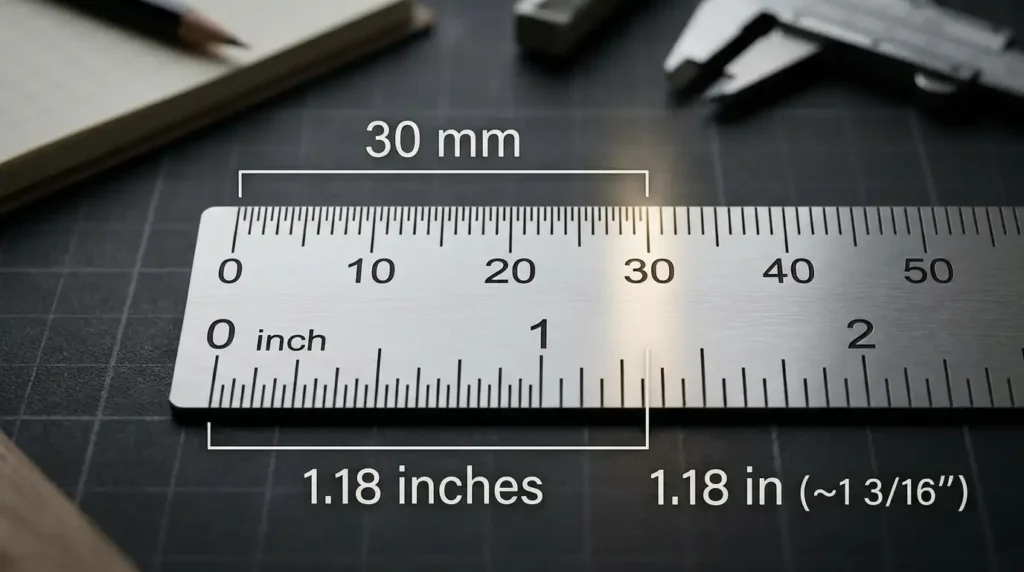
30 millimeters is equal to 1.18 inches.
To convert 30 mm to inches, divide 30 by 25.4.
30 ÷ 25.4 = 1.1811 inches
So, the simple answer is:
- 30 mm = 1.18 inches
- 30 mm = 1.1811 inches (more decimal places)
- 30 mm is about 1 3/16 inches (a nearby fraction)
Millimeters and inches are both units used to measure length. Millimeters are part of the metric system, while inches are part of the imperial system. You may need to change millimeters into inches when measuring tools, furniture, screens, pipes, building parts, or other objects.
This guide explains how to convert 30 mm to inches. It also shows the formula, the calculation, nearby measurements, and simple examples that make the conversion easy to understand.
Quick Answer: 30 mm in Inches
If you only need the result, you do not need to do a long calculation.
| Millimeters | Inches |
| 30 mm | 1.1811 inches |
| Rounded to 2 decimal places | 1.18 inches |
| Nearby fraction | 1 3/16 inches |
The exact decimal result from the standard conversion is 1.1811023622 inches. For most everyday uses, 1.18 inches is clear and easy to use.
Remember that 1 3/16 inches is a nearby fraction, not an exact match. Its value is 1.1875 inches.
How to Convert 30 mm to Inches
You can convert millimeters to inches with one simple rule.
Divide the number of millimeters by 25.4.
The number 25.4 is important because one inch contains exactly 25.4 millimeters.
For the 30 mm conversion, use this formula:
Inches = Millimeters ÷ 25.4
Now put 30 into the formula:
Inches = 30 ÷ 25.4
Inches = 1.1811023622
The result is about 1.18 inches.
This method works for any millimeter measurement. You only need to replace 30 with the number you want to convert.
For example:
- 10 mm ÷ 25.4 = 0.3937 inches
- 20 mm ÷ 25.4 = 0.7874 inches
- 40 mm ÷ 25.4 = 1.5748 inches
- 50 mm ÷ 25.4 = 1.9685 inches
The same rule works every time.
Why Do We Divide by 25.4?
The reason is simple: an inch is longer than a millimeter.
One inch is equal to 25.4 millimeters. This is a fixed measurement used in the standard conversion system.
When you change a smaller unit into a larger unit, the number becomes smaller. That is why you divide 30 by 25.4 instead of multiplying it.
Think about a ruler. If you measure a length in millimeters, you may get a larger number. If you measure the same length in inches, you get a smaller number because each inch is made up of 25.4 millimeters.
For example:
- 25.4 mm = 1 inch
- 50.8 mm = 2 inches
- 76.2 mm = 3 inches
Since 30 mm is a little more than 25.4 mm, its inch value must be a little more than 1 inch.
The answer of 1.1811 inches makes sense because it is slightly greater than one inch.
What Is a Millimeter?
A millimeter is a small unit used to measure length. It is part of the metric system, which is used in many countries around the world.
The short form of millimeter is mm.
Millimeters are useful when you need to measure small objects or short lengths. They can help you measure the thickness of a sheet, the size of a small part, or the width of an item.
Some simple facts about millimeters are:
- 10 millimeters make 1 centimeter.
- 1,000 millimeters make 1 meter.
- 25.4 millimeters make 1 inch.
A millimeter is small, so it is useful for measurements that need more detail than centimeters or meters can show.
For example, a small screw, a thin board, or a piece of plastic may be measured in millimeters.
What Is an Inch?
An inch is a unit of length used in the imperial and United States customary systems.
The short form of inch is in or the symbol ″.
Inches are often used to measure objects such as:
- Phone and computer screens
- Wooden boards
- Furniture
- Pipes
- Tools
- Picture frames
- Small building parts
One inch is equal to 25.4 millimeters. It is also equal to 2.54 centimeters.
There are 12 inches in one foot. This means that 12 inches make 1 foot.
Inches are common in the United States. They are also used in product sizes and measurements in many other places.
Is 30 mm More or Less Than One Inch?
30 mm is slightly more than one inch.
We know that:
1 inch = 25.4 mm
Now compare the two numbers:
30 mm − 25.4 mm = 4.6 mm
This means 30 mm is 4.6 mm longer than one inch.
In inches, the difference is:
4.6 ÷ 25.4 = 0.1811 inches
So, 30 mm is about 0.1811 inches longer than one inch.
This is why the final result is 1.1811 inches instead of exactly 1 inch.
30 mm to Inches in Fraction Form
Some people prefer fractions instead of decimal numbers. Fractions are common when working with rulers, wood, tools, and building materials.
The decimal result for 30 mm is:
1.1811 inches
A nearby fraction is:
1 3/16 inches
To understand this, first change the fraction into a decimal.
- 3 ÷ 16 = 0.1875
- 1 + 0.1875 = 1.1875 inches
Now compare the two values:
- 30 mm = 1.1811 inches
- 1 3/16 inches = 1.1875 inches
The difference is about 0.0064 inches.
This is a small difference, but the two measurements are not exactly the same. If you need a close measurement for a ruler or a basic project, the fraction may be useful. If you need a more accurate value, use 1.1811 inches.
30 mm to Inches Conversion Table
The table below shows how several nearby millimeter measurements compare in inches.
| Millimeters | Inches |
| 20 mm | 0.7874 in |
| 21 mm | 0.8268 in |
| 22 mm | 0.8661 in |
| 23 mm | 0.9055 in |
| 24 mm | 0.9449 in |
| 25 mm | 0.9843 in |
| 26 mm | 1.0236 in |
| 27 mm | 1.0630 in |
| 28 mm | 1.1024 in |
| 29 mm | 1.1417 in |
| 30 mm | 1.1811 in |
| 31 mm | 1.2205 in |
| 32 mm | 1.2598 in |
| 33 mm | 1.2992 in |
| 34 mm | 1.3386 in |
| 35 mm | 1.3780 in |
| 36 mm | 1.4173 in |
| 37 mm | 1.4567 in |
| 38 mm | 1.4961 in |
| 39 mm | 1.5354 in |
| 40 mm | 1.5748 in |
This table can help when you need to compare 30 mm with a nearby size. It is also useful when you are working with a ruler or measuring tool.
How to Convert Millimeters to Inches Without a Calculator
You can make a quick estimate without using a calculator.
Remember this rule:
25.4 mm is equal to 1 inch.
For 30 mm, you already know that 25.4 mm makes one inch. The remaining amount is 4.6 mm.
So:
- 25.4 mm = 1 inch
- 4.6 mm = about 0.1811 inches
- 30 mm = about 1.1811 inches
This gives you the same answer.
You can also use 25 mm as a quick guide. Since 25 mm is close to 25.4 mm, it is close to one inch. Therefore, 30 mm is a little more than one inch.
This method is useful when you only need an estimate. For exact work, use the full formula and a calculator.

Where Is a 30 mm Measurement Used?
A 30 mm measurement can appear in many everyday items. The exact use depends on the object and what part is being measured.
Here are some examples.
1. Furniture and Woodwork
People often use millimeters when measuring wood, shelves, boards, and furniture parts.
A 30 mm measurement may describe the thickness or width of a small part. If a plan gives the size in millimeters but your ruler uses inches, you can change the measurement to 1.18 inches.
For example, a woodworker may need to compare a 30 mm part with a board measured in inches. The conversion helps make the sizes easier to compare.
Always check whether the measurement refers to thickness, width, or length. These describe different parts of an object.
2. Tools and Machine Parts
Tools and machine parts often use millimeter measurements.
A small part may have a width, opening, or outside size of 30 mm. If you have an inch-based measuring tool, converting the size to 1.18 inches can help you understand it.
For machine work, do not rely only on a rounded value if the part must fit another part closely. Use the full measurement or the required tolerance given in the product plan.
3. Pipes and Fittings
Pipes and fittings can have measurements written in millimeters or inches.
A 30 mm measurement may refer to a part of a pipe or fitting, but it does not always mean the pipe’s inside width. Some products use outside measurements, while others use a named size.
For this reason, check the product details before buying a fitting. The conversion from 30 mm to 1.18 inches changes the unit, but it does not tell you which part of the pipe was measured.
4. Screens and Electronic Items
Screens are often sold using inch measurements. Small parts and product details may use millimeters.
A 30 mm length is about 1.18 inches. This can help when comparing a small part with a screen or another electronic item.
Remember that screen sizes are often measured across the diagonal, not across the width or height. A 30 mm measurement should not be treated as a screen size unless the product details say that it is.
5. Clothing and Accessories
Some clothing items and accessories use millimeters for small measurements.
For example, a small button, strap part, or metal fitting may have a size of 30 mm. Changing it to 1.18 inches can help someone who is more familiar with inches.
For clothing, it is important to check whether the measurement refers to the full width, inside opening, or another part.
6. Home Repair
Home repair tasks often involve measurements from different systems.
You may have a plan that gives a size in millimeters and a ruler that shows inches. In this case, knowing that 30 mm is about 1.18 inches can make the task easier.
It can help when measuring small boards, brackets, covers, and other parts.
For a close fit, use the exact decimal result rather than a rough estimate.
How Accurate Is 30 mm to Inches?
The standard conversion gives this result:
30 mm = 1.1811023622 inches
The number continues with more decimal places, so it is often shortened for everyday use.
Here are common ways to write the answer:
| Rounding | Result |
| Nearest whole inch | 1 inch |
| 1 decimal place | 1.2 inches |
| 2 decimal places | 1.18 inches |
| 3 decimal places | 1.181 inches |
| 4 decimal places | 1.1811 inches |
The best number of decimal places depends on the job.
For a simple answer, 1.18 inches is usually enough. For a more detailed calculation, 1.1811 inches gives more information.
Do not round too early if you need to complete more calculations. Keep the longer value during the work and round the final answer at the end.
Common Mistakes When Converting 30 mm to Inches
The conversion is simple, but a few mistakes can lead to the wrong answer.
Mistake 1: Multiplying Instead of Dividing
To convert millimeters into inches, divide by 25.4.
The correct calculation is:
30 ÷ 25.4 = 1.1811
Multiplying 30 by 25.4 gives the wrong result for this conversion.
Mistake 2: Using 25 Instead of 25.4
Some people use 25 because it is easy to remember. But the correct value is 25.4 millimeters per inch.
Using 25 gives:
30 ÷ 25 = 1.2 inches
This is close, but it is not the correct standard conversion.
Use 25.4 when you want the correct result.
Mistake 3: Rounding Too Soon
If you round 1.1811 to 1.2 at the start of another calculation, the final answer may be less accurate.
Keep the full result when possible. Round only when you are ready to write the final answer.
Mistake 4: Treating a Fraction as Exact
The fraction 1 3/16 inches is close to 30 mm, but it is not exact.
Its decimal value is 1.1875 inches, while 30 mm is 1.1811 inches.
Use the decimal result when the difference matters.
Mistake 5: Mixing Up Millimeters and Centimeters
There are 10 millimeters in one centimeter.
This means:
30 mm = 3 cm
It does not mean 30 mm is 30 cm.
Always check the unit before doing the calculation.
Millimeters, Centimeters, and Inches
It can be helpful to know how millimeters, centimeters, and inches are related.
| Unit | Value in Millimeters |
| 1 millimeter | 1 mm |
| 1 centimeter | 10 mm |
| 1 inch | 25.4 mm |
| 1 foot | 304.8 mm |
| 1 meter | 1,000 mm |
For the 30 mm measurement:
- In millimeters: 30 mm
- In centimeters: 3 cm
- In inches: 1.1811 inches
This gives you three ways to write the same length.
How to Use a Ruler to Check 30 mm
You can use a ruler to get a visual idea of the length.
First, find the inch markings on the ruler. Each large inch mark shows one full inch. The space between them is divided into smaller parts.
Since 30 mm is about 1.18 inches, the length is slightly more than one inch.
If your ruler has small marks for fractions, you can compare the length with 1 3/16 inches. Keep in mind that this fraction is close but not exact.
A ruler may not show every decimal value. For a more accurate measurement, use a suitable measuring tool and the full conversion.

Why Do Some Countries Use Millimeters and Others Use Inches?
Different countries and industries use different measurement systems.
The metric system uses units such as millimeters, centimeters, and meters. It is based on groups of ten, which makes many conversions simple.
For example:
- 10 mm = 1 cm
- 100 cm = 1 m
- 1,000 mm = 1 m
The inch system is used in the United States and in some products and industries around the world.
You may see inches used for screens, tools, furniture, and other products. You may also see millimeters used in engineering, building plans, and product details.
Because both systems are used, changing one unit into another is often helpful.
Quick Examples of Other Millimeter Conversions
Here are a few more examples using the same formula.
Example 1: Convert 15 mm to Inches
Divide 15 by 25.4.
15 ÷ 25.4 = 0.5906 inches.
Example 2: Convert 20 mm to Inches
Divide 20 by 25.4.
20 ÷ 25.4 = 0.7874 inches.
Example 3: Convert 25 mm to Inches
Divide 25 by 25.4.
25 ÷ 25.4 = 0.9843 inches.
Example 4: Convert 40 mm to Inches
Divide 40 by 25.4.
40 ÷ 25.4 = 1.5748 inches.
Example 5: Convert 50 mm to Inches
Divide 50 by 25.4.
50 ÷ 25.4 = 1.9685 inches.
These examples show that the same formula works for both small and large measurements.
Frequently Asked Questions
1. How many inches are in 30 mm?
There are about 1.18 inches in 30 mm. The longer decimal result is 1.1811 inches. To get this answer, divide 30 by 25.4.
2. Is 30 mm the same as 1 inch?
No. One inch is equal to 25.4 mm. A length of 30 mm is 4.6 mm longer than one inch. It is about 1.1811 inches.
3. What is 30 mm in inches as a fraction?
A nearby fraction is 1 3/16 inches. This fraction is not exact. The decimal value of 30 mm is 1.1811 inches, while 1 3/16 inches is 1.1875 inches.
4. How do I convert 30 mm to inches by hand?
Divide 30 by 25.4. The result is 1.1811023622 inches. You can round it to 1.18 inches for a simple answer.
5. Is 30 mm bigger than 25 mm?
Yes. The difference is 5 mm. Since 25.4 mm is equal to one inch, 25 mm is just under one inch, while 30 mm is a little more than one inch.
6. How many centimeters are in 30 mm?
There are 3 centimeters in 30 mm. Divide 30 by 10 to change millimeters into centimeters.
7. What is 30 mm rounded to one decimal place in inches?
30 mm is 1.2 inches when rounded to one decimal place. The more detailed value is 1.1811 inches.
8. Can I use 1.18 inches instead of 30 mm?
Yes, for many everyday tasks. However, 1.18 inches is a rounded value. If you need a close fit or a detailed measurement, use 1.1811 inches or keep the original 30 mm value.
Conclusion
30 mm is equal to 1.1811 inches, or about 1.18 inches. You can find this answer by dividing 30 by 25.4. The nearby fraction is 1 3/16 inches, but it is not an exact match.
This simple formula works for any millimeter measurement. Use 1.18 inches for a quick answer and the longer decimal value when you need more detail.

Chloe Harper writes clear, practical guides on measurements and unit conversions. She focuses on simple explanations and real-life examples so readers can get accurate answers quickly.