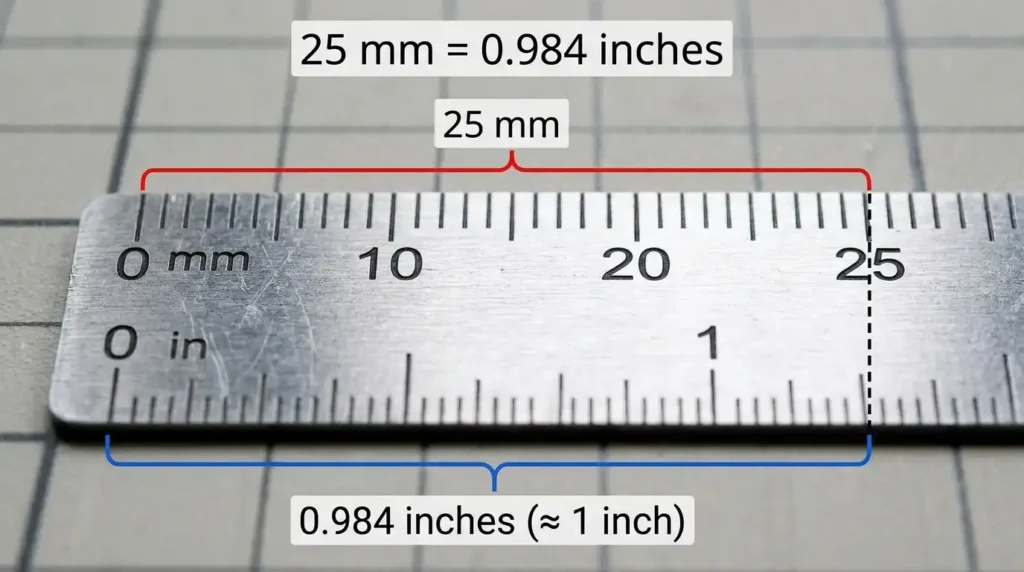
25 mm is equal to 0.9843 inches. It is almost 1 inch, but it is a little shorter. If you want a simple answer, 25 mm is about 0.98 inches.
Here are the main results:
- 25 mm = 0.9843 inches
- Rounded to two decimal places: 0.98 inches
- As a fraction: about 63/64 inch
- In centimeters: 2.5 cm
Millimeters and inches are units used to measure length. Millimeters are common in the metric system, while inches are used in the US and some other places.
You may need this conversion when measuring tools, furniture, small parts, or other items. Knowing how to change millimeters into inches makes it easier to understand sizes.
How to Convert 25 mm to Inches
Changing millimeters into inches is easy. You only need one simple formula.
Formula:
Inches = Millimeters ÷ 25.4
One inch is equal to exactly 25.4 millimeters. This is why you divide the millimeter value by 25.4.
Now, let’s use this formula to convert 25 mm.
Calculation:
25 ÷ 25.4 = 0.9842519685…
After rounding the answer to four decimal places:
25 mm = 0.9843 inches
You can also round the answer to two decimal places.
- Four decimal places: 0.9843 inches
- Three decimal places: 0.984 inches
- Two decimal places: 0.98 inches
These answers show the same size. The only difference is how many numbers appear after the decimal point.
If you need a close and simple answer, use 0.98 inches. If you need a more exact answer, use 0.9843 inches.
Is 25 mm Almost 1 Inch?
Yes. 25 mm is very close to 1 inch.
One inch is equal to 25.4 mm. The difference between 25 mm and 25.4 mm is only 0.4 mm.
This means that 25 mm is just a little shorter than 1 inch.
For a quick size check, you can think of 25 mm as almost 1 inch. This can help when looking at small objects or reading product sizes.
However, do not write 25 mm as exactly 1 inch when an exact size is needed. The correct value is 0.9843 inches.
For example, if you are buying a part that must fit into a small space, even a small size difference can matter. In that case, use the full number instead of rounding it to 1 inch.
Quick Conversion Chart for Millimeters to Inches
This chart shows common millimeter sizes and their values in inches. It also helps you compare 25 mm with smaller and larger sizes.
| Millimeters (mm) | Inches |
| 5 mm | 0.1969 in |
| 10 mm | 0.3937 in |
| 15 mm | 0.5906 in |
| 20 mm | 0.7874 in |
| 25 mm | 0.9843 in |
| 30 mm | 1.1811 in |
| 35 mm | 1.3780 in |
| 40 mm | 1.5748 in |
| 45 mm | 1.7717 in |
| 50 mm | 1.9685 in |
| 55 mm | 2.1654 in |
| 60 mm | 2.3622 in |
| 65 mm | 2.5591 in |
| 70 mm | 2.7559 in |
| 75 mm | 2.9528 in |
| 80 mm | 3.1496 in |
| 85 mm | 3.3465 in |
| 90 mm | 3.5433 in |
| 95 mm | 3.7402 in |
| 100 mm | 3.9370 in |
You can use this chart when you need to check a size quickly.
For example, 20 mm is 0.7874 inches, while 30 mm is 1.1811 inches. The size of 25 mm falls between these two values.
The chart also shows that 50 mm is close to 2 inches and 100 mm is close to 4 inches.
25 mm in Inches as a Fraction
Some people like to use fractions instead of decimal numbers. Fractions are often used on rulers and tape measures.
The decimal value of 25 mm is 0.9843 inches.
The nearest fraction using parts of 64 is 63/64 inch.
Here is a simple comparison:
- Decimal value: 0.9843 inches
- Fraction value: about 63/64 inch
- Full inch: 1 inch
The fraction 63/64 is very close to 1 inch, but it is not exactly the same as 25 mm.
To check the fraction, divide 63 by 64.
63 ÷ 64 = 0.984375 inches
This number is very close to 0.9843 inches.
The small difference comes from rounding the decimal value to a common fraction.
If you are using a ruler that shows fractions, 63/64 inch can help you find a nearby size. If you are using a calculator, the decimal answer is easier to use.

Understanding Millimeters, Centimeters, and Inches
It is helpful to know the difference between millimeters, centimeters, and inches. All three units are used to measure length, but they have different sizes.
What Is a Millimeter?
A millimeter is a small unit used to measure length. Its short form is mm.
Millimeters are part of the metric system. They are useful when you need to measure small objects or small changes in size.
For example, millimeters can be used to measure:
- The width of a small screw
- The thickness of a plastic sheet
- Small parts of a machine
- The size of a phone part
- The thickness of paper or cardboard
There are 1,000 millimeters in one meter. There are also 10 millimeters in one centimeter.
Because a millimeter is a small unit, it helps show sizes more clearly.
What Is an Inch?
An inch is another unit used to measure length.
Its short form is in. You may also see it written with this sign: “.
Inches are common in the US and in many product sizes.
For example, inches are used to measure:
- TV screens
- Furniture
- Pipes
- Tools
- Building parts
- Some household items
One inch is exactly equal to 25.4 millimeters.
This makes it easy to change an inch measurement into millimeters or change millimeters into inches.
What Is a Centimeter?
A centimeter is a metric unit used to measure length. Its short form is cm.
It is bigger than a millimeter but smaller than a meter.
There are 10 millimeters in 1 centimeter.
So, to change 25 mm into centimeters, divide 25 by 10.
25 ÷ 10 = 2.5 cm
This means:
25 mm = 2.5 cm
You can use centimeters when you want to understand the size without using very small numbers.
How to Change Millimeters to Inches Without a Calculator
You can get a quick answer without using a calculator. You only need to remember that 25.4 mm is equal to 1 inch.
For a simple estimate, you can think of 25 mm as almost 1 inch.
Here are some easy examples:
- 25 mm is almost 1 inch.
- 50 mm is almost 2 inches.
- 75 mm is almost 3 inches.
- 100 mm is almost 4 inches.
These numbers are useful when you only need a quick idea of the size.
However, they are not exact. If you need a correct answer, divide the millimeter value by 25.4.
For 25 mm:
25 ÷ 25.4 = 0.9843 inches
A calculator is helpful when you are measuring parts, cutting wood, or checking the size of something that must fit.
Where Is a 25 mm Measurement Used?
A size of 25 mm can be found in many types of work and products. Since it is almost 1 inch, it is easy to compare with inch measurements.
Here are some places where this conversion can be useful.
1. Tools and Small Parts
Tools and small parts often have sizes written in millimeters.
For example, a wrench, socket, nut, or bolt may have a size marked in mm.
If a tool is marked as 25 mm, its size is about 0.9843 inches.
This can help you compare metric tools with tools that use inches.
But do not assume that two tools will fit the same part just because their sizes are close. Always check the size before using a tool.
2. Building Work
Building work often uses both millimeters and inches.
People who work with wood, metal, plastic, and other materials may need to change one unit into another.
For example, a piece of material that is 25 mm thick is about 0.98 inches thick.
This can help when reading a plan or checking the size of a material.
Before cutting or joining any material, check the size carefully. A small difference can stop two parts from fitting together.
3. Furniture
Furniture sizes may be written in millimeters or inches.
A small furniture part that measures 25 mm is about 0.98 inches.
This may help when checking the thickness of a panel or the size of a small part.
When measuring furniture, check each side on its own. Length, width, and thickness are different measurements.
4. Online Products
Many online shops show product sizes in millimeters.
If you are more used to inches, changing the size can help you understand how large or small the product is.
For example, if a product has a size of 25 mm, you now know that it is almost 1 inch.
Before buying a product, check what the number means. It may show the length, width, height, or thickness of the item.

Common Mistakes When Changing 25 mm to Inches
Changing millimeters into inches is simple, but some mistakes can give you the wrong answer.
Here are a few things to avoid.
Mistake 1: Multiplying Instead of Dividing
When changing millimeters into inches, you must divide by 25.4.
The correct formula is:
Inches = Millimeters ÷ 25.4
For 25 mm:
25 ÷ 25.4 = 0.9843 inches
Do not multiply 25 by 25.4. That would give you the wrong answer.
Mistake 2: Saying 25 mm Is Exactly 1 Inch
25 mm is close to 1 inch, but it is not exactly equal to 1 inch.
One inch is 25.4 mm.
This means 25 mm is a little shorter than 1 inch.
For a quick estimate, you can say it is almost 1 inch. For an exact answer, use 0.9843 inches.
Mistake 3: Rounding Too Early
Rounding makes numbers shorter and easier to read. But rounding too early can change the final answer in a later calculation.
For example, 25 mm is 0.9843 inches.
If you change it to 0.98 inches before doing another calculation, the final answer may be a little different.
For better results, keep the full number while doing your work. Round only the final answer.
Mistake 4: Mixing Up Millimeters and Centimeters
Millimeters and centimeters are both metric units, but they are not the same.
There are 10 millimeters in 1 centimeter.
So:
25 mm = 2.5 cm
It does not equal 25 cm.
Always check the unit before using a measurement.
Frequently Asked Questions
1. How many inches are in 25 mm?
25 mm is equal to about 0.9843 inches. If you round it to two decimal places, the answer is 0.98 inches.
2. Is 25 mm the same as 1 inch?
No. One inch is equal to 25.4 mm. This means 25 mm is a little shorter than 1 inch.
3. What is 25 mm in inches as a fraction?
25 mm is about 63/64 inch when rounded to the nearest 1/64 inch. This is close to the exact value, but it is not a perfect match.
4. How many centimeters are in 25 mm?
25 mm is equal to 2.5 centimeters. To change millimeters into centimeters, divide the number by 10.
5. How do I change 25 mm into inches?
Divide 25 by 25.4. The answer is 0.9843 inches.
6. Is 0.98 inches the same as 0.9843 inches?
Both numbers show the same size, but 0.9843 is more exact. The number 0.98 is rounded to two decimal places.
7. How much less than 1 inch is 25 mm?
One inch is 25.4 mm. The difference is 0.4 mm, or about 0.0157 inches.
8. Can I use 25 mm instead of 1 inch?
You can use 25 mm as a quick estimate of 1 inch. But if you need a part to fit correctly, use the exact size instead.
Conclusion
Changing 25 mm to inches is easy when you know the formula. Divide 25 by 25.4 to get the answer.
The result is 0.9843 inches. If you round it to two decimal places, it becomes 0.98 inches.
A size of 25 mm is almost 1 inch, but it is a little shorter. Keep this in mind when reading product sizes, using tools, or working with both millimeters and inches.

Chloe Harper writes clear, practical guides on measurements and unit conversions. She focuses on simple explanations and real-life examples so readers can get accurate answers quickly.