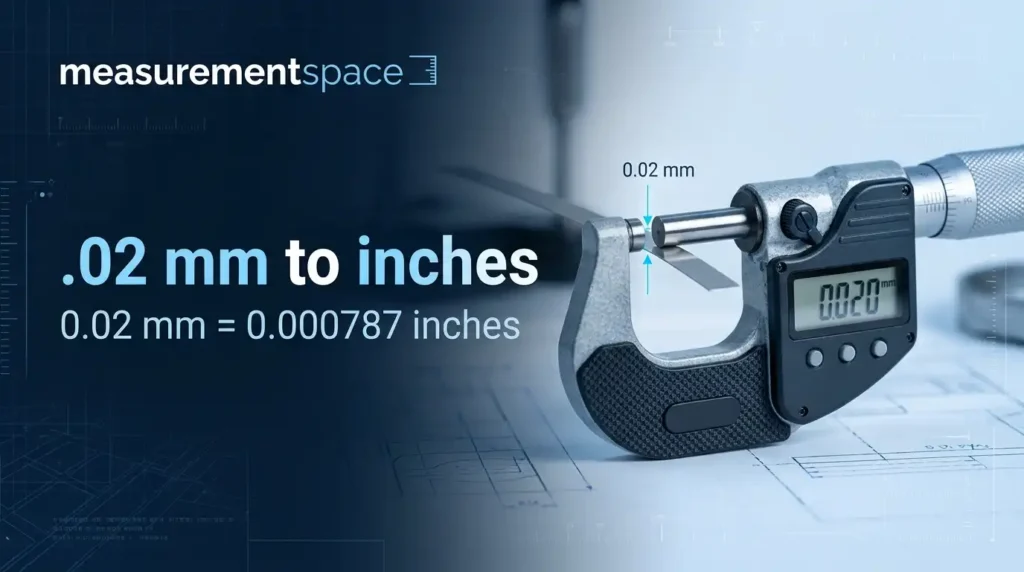
Converting millimeters to inches is useful in many daily tasks. People use this conversion when measuring small parts, checking product sizes, working on DIY projects, and reading technical drawings. If you need to convert 0.02 mm to inches, the answer is very small because a millimeter is already a small unit of length.
0.02 millimeters equals approximately 0.0007874 inches.
This guide explains how to convert 0.02 mm to inches, shows the formula, provides a conversion table, and answers common questions. The explanations use simple words to make the conversion easy to understand.
What Is 0.02 mm in Inches?
The direct answer is:
0.02 mm = 0.0007874 inches
You can also write this value in other ways, depending on how much detail you need.
- Exact conversion formula: 0.02 ÷ 25.4
- Decimal answer: 0.0007874016 inches (approximately)
- Rounded to four decimal places: 0.0008 inches
- In thousandths of an inch: 0.7874 mils (approximately)
A mil is one-thousandth of an inch. It is often used to measure thin materials, such as plastic films, coatings, and sheets.
The decimal answer may look long, but the calculation is simple. You only need to divide the millimeter value by 25.4.
How to Convert 0.02 mm to Inches
To convert millimeters to inches, divide the number of millimeters by 25.4. This works because one inch is equal to 25.4 millimeters.
The formula is:
Inches = Millimeters ÷ 25.4
Now, place 0.02 in the formula.
Step 1: Write the value
Millimeters = 0.02
Step 2: Divide by 25.4
0.02 ÷ 25.4 = 0.0007874016
Step 3: Round the answer if needed
The result is approximately 0.0007874 inches.
Therefore:
0.02 mm = 0.0007874 inches
You can use this formula to convert any millimeter value to inches. Simply replace 0.02 with the number you want to convert.
Why Do We Divide by 25.4?
The reason is the fixed relationship between millimeters and inches.
One inch contains exactly 25.4 millimeters. This means an inch is much larger than a millimeter. When you change a small millimeter value into inches, the number becomes smaller.
For example:
- 25.4 mm = 1 inch
- 12.7 mm = 0.5 inches
- 5 mm = 0.19685 inches
- 1 mm = 0.03937 inches
- 0.02 mm = 0.0007874 inches
As the millimeter value becomes smaller, the inch value also becomes smaller.
You should divide by 25.4 when changing millimeters to inches. If you want to change inches to millimeters, multiply the inch value by 25.4 instead.
Quick Conversion Table for 0.02 mm
The following table shows 0.02 mm in inches and other nearby millimeter values. It can help you compare small measurements quickly.
| Millimeters (mm) | Inches (in) |
| 0.01 mm | 0.0003937 in |
| 0.02 mm | 0.0007874 in |
| 0.03 mm | 0.0011811 in |
| 0.04 mm | 0.0015748 in |
| 0.05 mm | 0.0019685 in |
| 0.10 mm | 0.0039370 in |
| 0.20 mm | 0.0078740 in |
| 0.50 mm | 0.0196850 in |
| 1.00 mm | 0.0393701 in |
| 2.00 mm | 0.0787402 in |
These values are rounded for easy reading. Very small measurements may need more decimal places to keep the result useful for technical work.
What Does 0.02 mm Mean?
A millimeter is a unit used to measure length. It is part of the metric system, which is used in many countries around the world.
One millimeter is one-thousandth of a meter. It is also equal to 0.1 centimeters.
A measurement of 0.02 mm is much smaller than one millimeter. It is equal to two-hundredths of a millimeter.
In inches, this value is approximately 0.0007874 inches. Because the number is so small, it can be difficult to picture its size without a comparison.
Small measurements like this can matter when checking the thickness of a thin layer, the size of a gap, or the allowed difference between two parts. The importance of the value depends on the job and the measuring tools being used.
How to Round 0.02 mm to Inches
Sometimes you do not need the full decimal answer. You may only need a rounded value for a note, a school question, or a basic calculation.
The unrounded result is approximately:
0.0007874015748 inches
Here are common ways to round it:
| Rounding method | Result |
| Two decimal places | 0.00 in |
| Three decimal places | 0.001 in |
| Four decimal places | 0.0008 in |
| Five decimal places | 0.00079 in |
| Seven decimal places | 0.0007874 in |
Be careful when rounding very small numbers. If you round 0.0007874 to two decimal places, the result becomes 0.00. Although this is correct under that rounding rule, it hides the size of the original measurement.
For small measurements, four or more decimal places may be more useful. For detailed engineering or laboratory work, use the level of precision required by the task.
Convert 0.02 mm to Mils
Another way to express this measurement is in mils.
A mil is equal to 0.001 inches, or one-thousandth of an inch. Mils are often used to describe the thickness of coatings, sheets, wires, and films.
To convert inches to mils, multiply the inch value by 1,000.
First, convert 0.02 mm to inches:
0.02 ÷ 25.4 = 0.0007874016 inches
Then multiply by 1,000:
0.0007874016 × 1,000 = 0.7874016 mils
Therefore:
0.02 mm is approximately 0.7874 mils.
This value is less than one mil. The mil unit can make some small inch measurements easier to compare, especially when working with thin materials.

When Is This Conversion Useful?
Knowing how to convert 0.02 mm to inches can help in different types of work.
1. Engineering and Manufacturing
Engineers and factory workers often use both metric and imperial measurements. A drawing may show a measurement in millimeters, while a tool or machine uses inches.
Converting 0.02 mm to inches can help when reading a drawing or comparing small dimensions. However, always check the required precision before using the result in manufacturing.
2. DIY and Home Projects
People working on home repairs or small projects may need to compare measurements from different tools. Some measuring tools use millimeters, while others use inches.
The conversion formula makes it easier to compare values. For a measurement as small as 0.02 mm, a standard ruler will usually not provide enough detail to measure it accurately.
3. Science and Laboratory Work
Laboratory work can involve very small measurements. Researchers may need to convert values between metric and imperial units when reading equipment instructions or comparing data.
Keeping enough decimal places is important when recording very small values. Rounding too early can cause a loss of useful detail.
4. Thin Materials and Coatings
Some plastic films, surface coatings, and other thin materials are measured using small units. Mils may be used in some industries to describe thickness.
The value of 0.02 mm is approximately 0.7874 mils. This conversion can help when comparing measurements stated in different units.
5. Product Specifications
Products may be made or sold in countries that use different measurement systems. A specification may list a size in millimeters, while another source lists inches.
Converting the values helps you compare them using the same unit. Always check whether the listed number refers to thickness, length, width, or another measurement.
Common Mistakes When Converting Millimeters to Inches
A few simple mistakes can lead to an incorrect answer.
Multiplying instead of dividing: When converting millimeters to inches, divide by 25.4. Multiplication by 25.4 is used for the reverse conversion, from inches to millimeters.
Using the wrong conversion number: One inch equals 25.4 millimeters. Use this number for the standard conversion.
Removing too many decimal places: Small values can become zero when rounded too much. Keep enough decimal places for the purpose of your calculation.
Confusing millimeters with centimeters: One centimeter equals 10 millimeters. A value in centimeters will not have the same size as the same number in millimeters.
Forgetting the unit: Always write “inches” or “in” beside your final answer. This makes it clear which measurement system you are using.
Easy Way to Remember the Formula
You can remember the conversion with one simple rule:
- Millimeters to inches: divide by 25.4.
- Inches to millimeters: multiply by 25.4.
For example, to convert 0.02 mm to inches:
0.02 ÷ 25.4 = 0.0007874 inches
To check the result, multiply the inch value by 25.4:
0.0007874 × 25.4 ≈ 0.02 mm
The result is slightly rounded, but it returns approximately to the original value. This is a useful way to check your work.
Frequently Asked Questions
1. How many inches are in 0.02 mm?
There are approximately 0.0007874 inches in 0.02 mm. To get this answer, divide 0.02 by 25.4.
2. Is 0.02 mm the same as 0.001 inches?
No. A value of 0.02 mm is approximately 0.0007874 inches. A value of 0.001 inches is equal to 0.0254 mm, which is slightly larger.
3. How do I convert 0.02 mm to inches without a calculator?
Write the formula as millimeters divided by 25.4. Then divide 0.02 by 25.4 to get approximately 0.0007874 inches. For an exact practical result, a calculator is helpful because the answer has several decimal places.
4. Can I round 0.02 mm to 0.0008 inches?
Yes. Rounded to four decimal places, 0.0007874 inches becomes 0.0008 inches. This is suitable for some general uses, but detailed work may require more decimal places.
5. What is 0.02 mm in mils?
The value is approximately 0.7874 mils. To convert millimeters to mils, divide the millimeter value by 0.0254 or convert it to inches and multiply by 1,000.
Conclusion
Converting 0.02 mm to inches is easy when you know the correct formula. Divide the millimeter value by 25.4 to get the answer. The result is approximately 0.0007874 inches, or 0.0008 inches when rounded to four decimal places. You can also express it as about 0.7874 mils. Keep enough decimal places when working with very small measurements, and always use the level of accuracy required for your task.

Chloe Harper writes clear, practical guides on measurements and unit conversions. She focuses on simple explanations and real-life examples so readers can get accurate answers quickly.