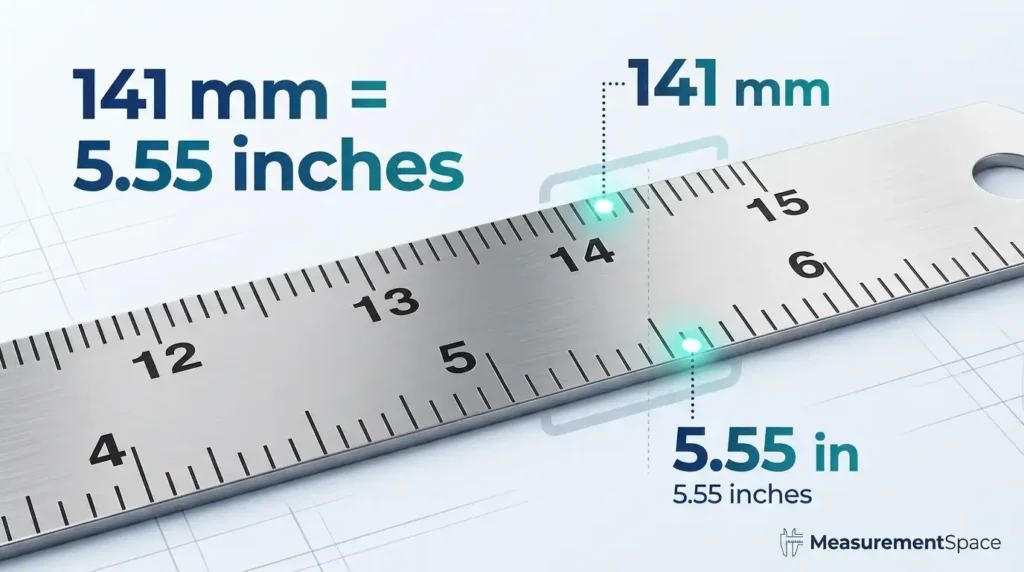
141 mm equals about 5.55 inches (about 5 35/64 inches). To change 141 millimeters to inches, divide 141 by 25.4. The result is about 5.5512 inches before rounding.
This measurement is useful when checking the size of small items, working on craft projects, measuring parts, or comparing sizes. You can also write 141 mm as 14.1 centimeters or about 5 1/2 inches.
How to Convert 141 mm to Inches

Changing millimeters to inches is easy when you know the right formula. Both millimeters and inches are units used to measure length. Millimeters are part of the metric system, while inches are used in the US and other places.
One inch is exactly equal to 25.4 millimeters.
The formula for millimeters to inches
Use this formula to change any millimeter measurement into inches:
Inches = Millimeters ÷ 25.4
For 141 mm, the calculation is:
141 ÷ 25.4 = 5.5511811024 inches
Rounded to two decimal places, 141 mm equals 5.55 inches.
Step-by-step calculation
Follow these simple steps to change 141 mm into inches.
- Start with the measurement: You have 141 mm.
- Use the conversion number: One inch equals 25.4 mm.
- Divide the numbers: Divide 141 by 25.4.
- Find the answer: The result is about 5.5512 inches.
- Round the answer: Round to two decimal places to get 5.55 inches.
The final answer is 141 mm = 5.55 inches, rounded to two decimal places.
Why do you divide by 25.4?
You divide by 25.4 because an inch is longer than a millimeter. It takes 25.4 millimeters to make one inch, so the number becomes smaller when you change millimeters into inches.
For example, 25.4 mm equals exactly 1 inch. In the same way, 50.8 mm equals exactly 2 inches because 50.8 divided by 25.4 equals 2.
The same rule works for 141 mm. Dividing by 25.4 gives the length in inches.
Quick Conversion Chart for 141 mm and Nearby Sizes
The chart below shows 141 mm and other nearby measurements in inches. You can use it to find the inch value of a similar measurement without doing the calculation yourself.
| Millimeters (mm) | Inches (in) | Approximate fraction |
|---|---|---|
| 121 mm | 4.76 in | 4 49/64 in |
| 131 mm | 5.16 in | 5 5/32 in |
| 136 mm | 5.35 in | 5 23/64 in |
| 141 mm | 5.55 in | 5 35/64 in |
| 146 mm | 5.75 in | 5 3/4 in |
| 151 mm | 5.94 in | 5 15/16 in |
| 161 mm | 6.34 in | 6 11/32 in |
| 171 mm | 6.73 in | 6 47/64 in |
| 181 mm | 7.13 in | 7 9/64 in |
| 191 mm | 7.52 in | 7 21/32 in |
The inch values are rounded to two decimal places. The fractions are close values rounded to the nearest 1/64 inch.
How to read the chart
Find your measurement in millimeters in the first column. Then look across the same row to find the value in inches.
For example, 146 mm is about 5.75 inches, which is the same as 5 3/4 inches when using that fraction.
If your measurement is 141 mm, look at the bold row. The decimal value is 5.55 inches, which is a little more than 5 1/2 inches.
How Big Is 141 mm in Real Life?
A length of 141 mm equals 14.1 cm or about 5.55 inches. This makes it easier to picture the size without using a calculator.
It is a little longer than 5 1/2 inches but shorter than 6 inches. The difference between 141 mm and 6 inches is 11.4 mm because 6 inches equals 152.4 mm.
Here are some easy ways to compare this length with other measurements.
Comparing 141 mm with 5 inches
Five inches equals exactly 127 mm. This means 141 mm is 14 mm longer than 5 inches.
This comparison can help you picture the length of a small item. If you know how long 5 inches is on a ruler, think of 141 mm as a little longer.
Comparing 141 mm with 5 1/2 inches
Five and a half inches equals 139.7 mm. This means 141 mm is only 1.3 mm longer than 5 1/2 inches.
The two sizes are very close, but they are not exactly the same. If you need two parts to fit together, even a small difference can matter.
Comparing 141 mm with 6 inches
Six inches equals 152.4 mm. Since 141 mm is less than 152.4 mm, it is shorter than 6 inches.
The difference is 11.4 mm, or about 0.45 inches. This means 141 mm is a little less than half an inch shorter than 6 inches.
Using a ruler to measure 141 mm
If you have a ruler marked in inches, start at the 5-inch mark and move forward about 0.55 inches. This will bring you close to 5.55 inches.
If your ruler is marked in millimeters, find the 141 mm mark directly. A ruler with millimeter marks can make this measurement easier to read.
Remember that looking at an object and guessing its size is not as accurate as using a ruler.
Where Can You Use a 141 mm Measurement?
A measurement of 141 mm can be used for length, width, height, or other straight-line measurements. The meaning depends on the item you are measuring.
Here are some examples of when this conversion may help.
1. Household items and accessories
You may see a size close to 141 mm when checking small household items, storage boxes, or personal accessories.
Changing the measurement into inches can help you check whether an item will fit in a space. For example, if a shelf is measured in inches but an item is listed in millimeters, changing both measurements into the same unit makes them easier to compare.
Always check the item’s listed size before buying it.
2. DIY and craft projects
People who make crafts or work on home projects may need to change millimeters into inches.
For example, a project may need a piece of material that is 141 mm long, but the ruler or instructions may use inches. Changing the measurement gives you about 5.55 inches.
If the size must be exact, use the full decimal value or measure directly in millimeters instead of using only the rounded answer.
3. Machine parts and tools
Millimeters are often used to measure machine parts, tools, and other items. A measurement of 141 mm may describe the length or width of a part.
Changing it into inches can help when comparing items that use different measurement systems.
However, two parts with similar sizes may not fit together. Their shape, material, and allowed size difference may also matter.
How to Convert Inches Back to Millimeters
Sometimes, you may need to change inches back into millimeters. For example, a product may be listed as 5.55 inches, but you want to know its size in millimeters.
Use this formula:
Millimeters = Inches × 25.4
Suppose you want to change 5.55 inches into millimeters.
5.55 × 25.4 = 140.97 mm
Therefore, 5.55 inches equals 140.97 mm.
Notice that this is not exactly 141 mm. This small difference happens because 5.55 inches is a rounded value.
If you use the longer answer of 5.5511811024 inches, multiplying it by 25.4 gives about 141 mm.
Reverse conversion examples
| Inches | Calculation | Millimeters |
|---|---|---|
| 5 inches | 5 × 25.4 | 127 mm |
| 5.5 inches | 5.5 × 25.4 | 139.7 mm |
| 5.55 inches | 5.55 × 25.4 | 140.97 mm |
| 6 inches | 6 × 25.4 | 152.4 mm |
This formula works for any measurement in inches. Multiply the number of inches by 25.4 to get millimeters.
Understanding Millimeters, Centimeters, and Inches
Millimeters, centimeters, and inches are all used to measure length. The main difference is the size of each unit.
Learning how these units work together makes changing measurements easier.
| Unit | Equivalent measurement |
|---|---|
| 1 millimeter | 0.1 centimeters |
| 10 millimeters | 1 centimeter |
| 25.4 millimeters | 1 inch |
| 1 centimeter | About 0.3937 inches |
| 1 inch | 2.54 centimeters |
| 141 millimeters | 14.1 centimeters |
| 141 millimeters | About 5.5512 inches |
Millimeters
Millimeters are small units used to measure length. They are common when measuring small objects, machine parts, and materials.
There are 1,000 millimeters in one meter. Using millimeters helps you write small measurements clearly.
For example, 141 mm gives a more exact size than simply saying an object is about 14 cm long.
Centimeters
A centimeter equals 10 millimeters. Centimeters are often used to measure everyday items, such as books, boxes, and small accessories.
To change 141 mm into centimeters, divide by 10:
141 ÷ 10 = 14.1 cm
This answer is exact because 10 millimeters always equal 1 centimeter.
Inches
Inches are used in the US and in many products around the world. They are common in product sizes, tools, and building work.
To change millimeters into inches, divide by 25.4. To change inches into millimeters, multiply by 25.4.
For 141 mm, the answer is about 5.55 inches.
Common Mistakes When Converting 141 mm to Inches
Changing millimeters into inches is simple, but a few common mistakes can lead to the wrong answer.
Mistake 1: Multiplying instead of dividing
One common mistake is multiplying 141 by 25.4 when changing millimeters into inches.
This is wrong because the formula works in the opposite direction. The correct calculation is:
141 ÷ 25.4 = 5.5511811024 inches
Only multiply by 25.4 when changing inches into millimeters.: Rounding the answer too early
Rounding the answer too soon can cause small differences in later calculations.
For example, using 5.55 inches instead of the longer answer gives 140.97 mm when you change it back into millimeters.
For simple measurements, two decimal places are often enough. If you need a more exact answer, keep more decimal places during the calculation and round only at the end.
Mistake 3: Thinking an approximate fraction is exact
The decimal value of 141 mm is about 5.55118 inches. The closest fraction to the nearest 1/64 inch is about 5 35/64 inches.
These values are not exactly the same. The fraction is useful when reading a ruler, while the decimal gives a more exact value.
Mistake 4: Mixing up millimeters and centimeters
A measurement of 141 mm equals 14.1 cm, not 141 cm.
There are 10 millimeters in every centimeter. Always check the unit before doing the calculation.
Frequently Asked Questions
1. How many inches is 141 mm?
141 mm equals about 5.55 inches. The longer decimal answer is 5.5511811024 inches before rounding.
2. Is 141 mm the same as 5.5 inches?
No. Five and a half inches equals exactly 139.7 mm. Therefore, 141 mm is 1.3 mm longer than 5.5 inches.
3. How many centimeters is 141 mm?
141 mm equals exactly 14.1 centimeters. Divide the millimeter value by 10 to change it into centimeters.
4. What is 141 mm as a fraction of an inch?
141 mm is about 5 35/64 inches when rounded to the nearest 1/64 inch. Its decimal value is about 5.5512 inches.
5. Is 141 mm closer to 5 inches or 6 inches?
141 mm is closer to 6 inches than to 5 inches. It is about 0.55 inches longer than 5 inches and about 0.45 inches shorter than 6 inches.
6. How can I change 141 mm into inches without a calculator?
Divide 141 by 25.4. You can also remember that 140 mm is about 5.51 inches, so 141 mm is about 5.55 inches.
For a more exact answer, use a calculator or a conversion chart.
7. How many millimeters are in 6 inches?
Six inches equals exactly 152.4 mm. Multiply 6 by 25.4 to get the answer.
8. Why do some websites show different answers for 141 mm?
Some websites round the answer to different numbers of decimal places. One may show 5.55 inches, while another shows 5.5512 inches. Both are correct rounded answers.
Conclusion
141 mm equals about 5.55 inches, or about 5 35/64 inches when rounded to the nearest 1/64 inch. To get the answer, divide 141 by 25.4. The longer decimal answer is 5.5511811024 inches.
You can also write 141 mm as exactly 14.1 cm. Whether you are checking product sizes, working on a craft project, or comparing measurements, using the correct formula helps you get the right answer.
The easiest answer to remember is 141 mm = 5.55 inches (approximately).
– 3 internal link anchor ideas:
- Millimeters to inches conversion chart
- How to change inches to millimeters
- Millimeters to centimeters conversion guide
– Type used: T1 — Simple conversion. The article gives the answer first and explains the formula, calculation, chart, common uses, mistakes, and FAQs in simple language.
– Calculation sheet:
- Main answer: 141 mm × (1 in ÷ 25.4 mm) = 5.5511811024 in ≈ 5.55 in
- Table row 1: 136 mm × (1 in ÷ 25.4 mm) = 5.3543307087 in ≈ 5.35 in
- Table row 2: 146 mm × (1 in ÷ 25.4 mm) = 5.7480314961 in ≈ 5.75 in
– Accuracy notes: One inch equals exactly 25.4 mm. The main answer is rounded to two decimal places. The nearest 1/64-inch fraction is about 5 35/64 inches. Actual product sizes may vary.

Chloe Harper writes clear, practical guides on measurements and unit conversions. She focuses on simple explanations and real-life examples so readers can get accurate answers quickly.