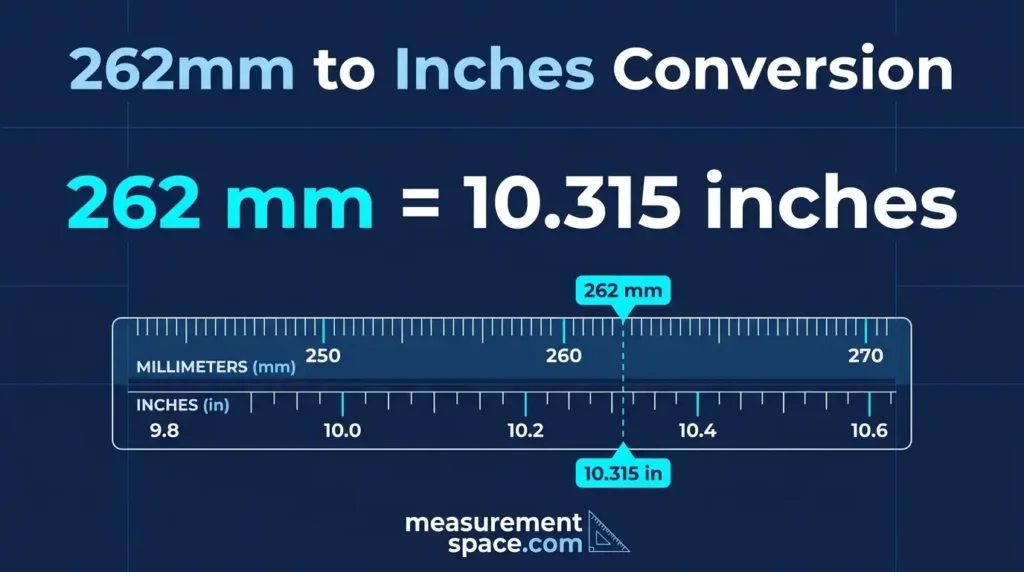
262 mm is equal to 10.31496 inches, or approximately 10.31 inches. Rounded to the nearest 1/16 inch, this measurement is about 10 5/16 inches. In centimeters, 262 mm equals 26.2 cm.
Converting millimeters to inches is useful when working with metric measurements and imperial measuring tools. Whether you are measuring a component, checking an object’s dimensions, or following a DIY project plan, knowing the correct conversion helps you work more accurately.
How Many Inches Is 262 mm?
The exact mathematical conversion of 262 millimeters is approximately 10.31496063 inches.
Here are the most useful equivalents:
- Millimeters: 262 mm
- Decimal inches: 10.31496 inches
- Rounded inches: 10.31 inches
- Approximate fractional inches: 10 5/16 inches
- Centimeters: 26.2 cm
The decimal-inch value is useful for calculations and precise measurements. The rounded decimal and fractional values are convenient when reading a standard inch ruler or measuring tape.
Remember that 10.31 inches is a rounded result. It is not the exact mathematical value of 262 mm.
How to Convert 262 mm to Inches
Converting millimeters to inches is straightforward. Divide the millimeter value by 25.4 because one international inch is defined as exactly 25.4 millimeters.
The conversion formula
Inches = Millimeters ÷ 25.4
To convert 262 mm to inches, substitute 262 for the millimeter value:
262 ÷ 25.4 = 10.31496063 inches
Therefore:
262 mm ÷ 25.4 = 10.31496 inches
Rounded to two decimal places, the result is 10.31 inches.
An alternative multiplication method
You can also multiply millimeters by the conversion factor 0.03937007874.
The formula is:
Inches = Millimeters × 0.03937007874
For 262 mm:
262 × 0.03937007874 ≈ 10.31496 inches
Both methods produce the same result when sufficient precision is retained.
Dividing by 25.4 is usually the simplest method to remember. Multiplication is also convenient when using a calculator or spreadsheet.
262 mm to Inches Conversion Chart
The following chart shows 262 mm alongside nearby measurements. It can help you compare dimensions without repeating the conversion calculation.
| Millimeters (mm) | Inches (decimal) | Approximate fraction |
| 240 mm | 9.45 in | 9 29/64 in |
| 245 mm | 9.65 in | 9 21/32 in |
| 250 mm | 9.84 in | 9 27/32 in |
| 255 mm | 10.04 in | 10 1/32 in |
| 260 mm | 10.24 in | 10 15/64 in |
| 262 mm | 10.31 in | 10 5/16 in |
| 265 mm | 10.43 in | 10 7/16 in |
| 270 mm | 10.63 in | 10 5/8 in |
| 275 mm | 10.83 in | 10 53/64 in |
| 280 mm | 11.02 in | 11 1/64 in |
| 285 mm | 11.22 in | 11 7/32 in |
| 290 mm | 11.42 in | 11 27/64 in |
| 300 mm | 11.81 in | 11 13/16 in |
Decimal values are rounded to two decimal places. Fractional values are approximate and rounded to the nearest 1/64 inch.
The bold row identifies the requested measurement. If you only need a quick answer, remember that 262 mm is approximately 10.31 inches.
Is 262 mm the Same as 10 5/16 Inches?
Not exactly. The two measurements are very close, but there is a small difference.
To compare them, first convert the fraction to a decimal:
10 5/16 inches = 10 + (5 ÷ 16)
10 5/16 inches = 10.3125 inches
The more precise conversion of 262 mm is approximately 10.31496063 inches.
The difference is:
10.31496063 − 10.3125 ≈ 0.00246 inches
Therefore, 10 5/16 inches is approximately 0.00246 inches shorter than 262 mm.
For many everyday tasks, this difference is small. However, if you are measuring parts that must fit together precisely, use the exact metric dimension or a sufficiently precise decimal conversion instead of assuming the fraction is identical.
How to Read 262 mm on an Inch Ruler
If you have an inch ruler rather than a metric ruler, you can locate the approximate position of 262 mm by converting it to inches first.
Since 262 mm equals approximately 10.315 inches, the measurement falls slightly beyond the 10 5/16-inch mark.
Here is how to find it:
- Locate the 10-inch mark on the ruler.
- Find the 5/16-inch mark after 10 inches, if your ruler includes sixteenth-inch divisions.
- Move a very small distance beyond that mark to represent the additional 0.00246 inches.
- If your ruler only has larger divisions, use the nearest mark as an estimate rather than treating it as an exact measurement.
Many ordinary rulers are not precise enough to show this small difference. A metric ruler, digital caliper, or suitable measuring instrument may be more useful when accuracy matters.
Where Is a 262 mm Measurement Useful?
A length of 262 mm, or about 10.31 inches, can appear in many types of measurement tasks. The meaning of the measurement depends on the object being measured.
1. Tools and hardware
You may need to convert a 262 mm measurement when checking the length of a tool, a mechanical component, or a manufactured part. Converting the value to inches can make it easier to compare with imperial measurements on a drawing or specification sheet.
Do not assume that a nearby fractional size is interchangeable with the metric measurement. Fit, clearance, and manufacturing tolerances may matter.
2. DIY and home improvement
Metric and imperial measurements sometimes appear together in renovation instructions, furniture plans, and workshop projects. Converting 262 mm to approximately 10.31 inches lets you transfer the measurement to an inch-based plan.
For cutting or drilling, confirm the required tolerance and use a measuring tool suitable for the job.
3. Checking object dimensions
If a product lists a dimension of 262 mm, converting it to 10.31 inches can help you determine whether it fits within an available space.
First, confirm whether 262 mm refers to length, width, height, depth, or diameter. A single measurement does not describe the complete size of an object.
Millimeters, Centimeters, and Inches Explained
centimeters, and inches are units of length, but they belong to different measurement systems.
Millimeters (mm) are metric units commonly used for small dimensions, machine parts, material thicknesses, and precise measurements.
Centimeters (cm) are also metric units. One centimeter equals 10 millimeters, so 262 mm equals 26.2 cm.
Inches (in) are commonly used in the imperial and US customary measurement systems. One inch equals exactly 25.4 millimeters.
For the requested measurement, the relationships are:
- 262 mm = 26.2 cm
- 262 mm ≈ 10.31496 inches
- 10.31496 inches ≈ 10.31 inches when rounded to two decimal places
Using the correct unit is important because length, area, and volume are different quantities. Millimeters convert directly to inches because both measure length, but square millimeters and cubic millimeters require different conversion factors.
Common Mistakes When Converting Millimeters to Inches
A few simple errors can lead to incorrect results.
Dividing by 10 instead of 25.4
Dividing 262 by 10 gives 26.2, but the result is centimeters, not inches.
To convert millimeters to inches, divide by 25.4.
Rounding too early
If you round the conversion factor or an intermediate result too soon, the final answer may be less accurate. Keep several decimal places during the calculation and round only the displayed result.
Treating a fraction as exact
The fraction 10 5/16 inches is a useful approximation of 262 mm, but it is not mathematically identical. This distinction matters for precision work.
Confusing length with diameter
A measurement of 262 mm could describe a straight length or the diameter of a circular object. The conversion remains the same, but the physical meaning differs. Always retain the original dimension label when using the result.
Frequently Asked Questions
1. How many inches are in 262 mm?
262 mm equals approximately 10.31496 inches, or 10.31 inches when rounded to two decimal places.
2. What is 262 mm in fractions of an inch?
262 mm is approximately 10 5/16 inches when rounded to the nearest 1/16 inch. The fractional measurement is slightly shorter than the original metric value.
3. How many centimeters is 262 mm?
262 mm equals 26.2 cm. Divide millimeters by 10 to convert them to centimeters.
4. Is 262 mm more than 10 inches?
Yes. Ten inches equals 254 mm, so 262 mm is 8 mm longer than 10 inches. In decimal inches, the difference is approximately 0.315 inches.
5. How do I convert inches back to millimeters?
Multiply the inch value by 25.4.
For example, 10.31496063 inches multiplied by 25.4 gives approximately 262 mm.
6. What is the easiest way to convert millimeters to inches?
Divide the millimeter measurement by 25.4. For 262 mm, the calculation is 262 ÷ 25.4 = approximately 10.31496 inches.
Conclusion
Converting 262 mm to inches requires only one calculation: divide 262 by 25.4. The result is approximately 10.31496 inches, which rounds to 10.31 inches or about 10 5/16 inches to the nearest 1/16 inch.
Use the decimal value when precision is important and the fractional value when you need a convenient ruler reference. Always consider the required tolerance before substituting one measurement for another.

Chloe Harper writes clear, practical guides on measurements and unit conversions. She focuses on simple explanations and real-life examples so readers can get accurate answers quickly.