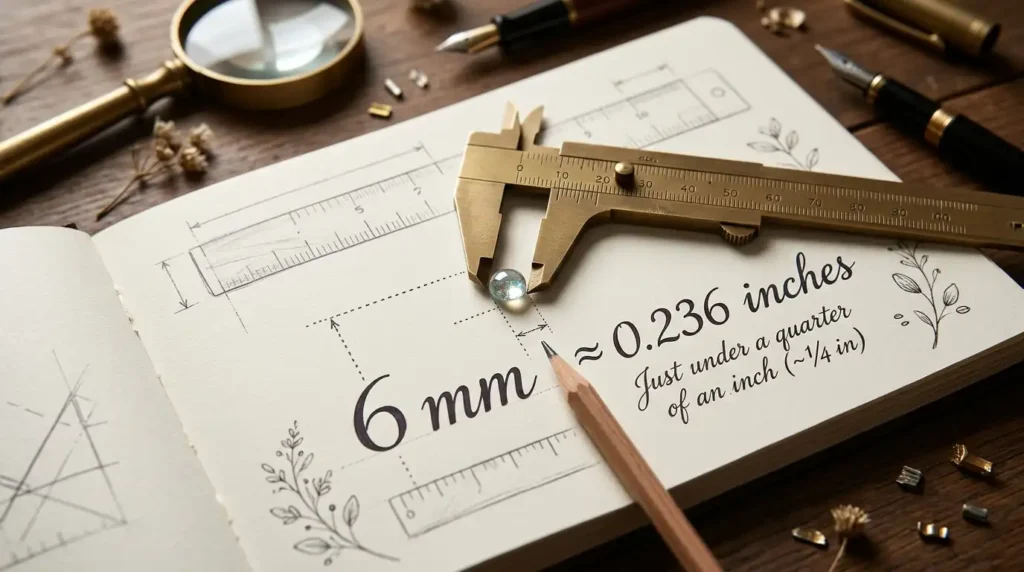

6 mm is approximately 0.2362 inches, or exactly 0.6 centimeters. It is slightly smaller than 1/4 inch, which measures 0.25 inches. Although 6 mm is a small measurement, it can help when measuring hardware, small components, thin materials, and other objects.
If you are trying to picture this size, think of a measurement that is a little less than one-quarter of an inch. You can also compare it with familiar objects, such as a US quarter, an AA battery, or the width of a credit card.

How Big Is 6 mm in Inches and Centimeters?
Here is the size of 6 millimeters in different units:
| Measurement | Equivalent |
| Millimeters | 6 mm |
| Inches | 0.2362 inches |
| Centimeters | 0.6 cm |
| Fraction of an inch | About 15/64 inch |
| Comparison | Slightly smaller than 1/4 inch |
The decimal measurement is useful when you need a precise conversion for calculations or measurements. The centimeter value is easier to understand if you normally use the metric system.
The fractional value is an approximation. It can be useful when working with an inch ruler, but it is not exactly equal to 6 mm.
What Does 6 mm Look Like?
Six millimeters is not a large measurement. It is less than one-quarter of an inch, so it may be difficult to judge by looking at it without a reference.
A few familiar objects can help you understand the size.
1. Compared With a US Quarter
A US quarter has a diameter of approximately 24.26 mm. A 6 mm measurement is about one-quarter of that diameter.
Imagine dividing the diameter of a quarter into four equal parts. Each part would be a little over 6 mm.
This comparison helps you understand how small 6 mm is. Remember that the comparison uses the quarter’s diameter, not its thickness.
2. Compared With an AA Battery
An AA battery is about 14.5 mm thick across its diameter. A 6 mm measurement is less than half of that distance.
This gives you another way to picture the size. If you compare 6 mm with the width of an AA battery, the measurement will look relatively small.
Battery dimensions can vary slightly by product, so use this comparison only as a visual guide.
3. Compared With a Credit Card
A standard credit card is approximately 54 mm wide. Six millimeters is about one-ninth of that width.
For example, if you imagine dividing the card’s shorter side into nine equal sections, each section would be about 6 mm wide.
This is a useful comparison because most people have seen or used a standard payment card. However, do not use a credit card as a precision measuring tool.
Is 6 mm Bigger or Smaller Than 1/4 Inch?
6 mm is slightly smaller than 1/4 inch.
To understand the difference, compare their decimal measurements:
- 6 mm = approximately 0.2362 inches
- 1/4 inch = exactly 0.25 inches
The difference is approximately 0.0138 inches.
That means 1/4 inch is a little larger than 6 mm. The measurements are close, but they are not identical.
This difference matters when choosing hardware, measuring small openings, or working with parts that need to fit correctly. A small difference may affect whether two components fit together.

How to Convert 6 mm to Inches
You can convert millimeters into inches with a simple division formula.
Formula:
Inches = Millimeters ÷ 25.4
There are exactly 25.4 millimeters in one inch. Therefore, divide the millimeter measurement by 25.4 to find its equivalent in inches.
Step-by-step calculation:
- Start with the measurement: 6 mm.
- Divide 6 by 25.4.
- The result is 0.2362204724…
- Round the result to four decimal places.
Final result: 6 mm = approximately 0.2362 inches.
You can use the same formula for other millimeter measurements. For example, 5 mm is approximately 0.1969 inches, while 7 mm is approximately 0.2756 inches.
Quick Millimeters to Inches Chart
The following chart shows 6 mm alongside nearby measurements. It can help you compare sizes without repeating the conversion calculation.
| Millimeters (mm) | Inches (decimal) |
| 3 mm | 0.1181 inches |
| 4 mm | 0.1575 inches |
| 5 mm | 0.1969 inches |
| 6 mm | 0.2362 inches |
| 7 mm | 0.2756 inches |
| 8 mm | 0.3150 inches |
| 9 mm | 0.3543 inches |
| 10 mm | 0.3937 inches |
Each inch value is rounded to four decimal places. The original millimeter measurements are exact values in this chart.
How to Measure 6 mm Without a Ruler
If you do not have a ruler, you can estimate 6 mm by comparing it with a familiar object. However, remember that these methods only provide an approximate idea of the size.
Here are a few practical ways to picture the measurement:
Use a credit card as a reference: A standard credit card is about 54 mm wide. Six millimeters is roughly one-ninth of that width. This can help you estimate the distance visually.
Compare it with an AA battery: An AA battery is approximately 14.5 mm across its diameter. Six millimeters is less than half of that measurement.
Use a quarter for comparison: A US quarter is approximately 24.26 mm across. Six millimeters is close to one-quarter of its diameter.
For an accurate measurement, use a metric ruler, digital caliper, or another suitable measuring tool. Visual comparisons are not reliable enough for work that requires precise dimensions.
Where Can a 6 mm Measurement Be Useful?
A 6 mm measurement can appear in different everyday and practical situations. Its meaning depends on what you are measuring.
Small Hardware and Components
Small mechanical parts, fittings, and hardware may have dimensions measured in millimeters. A 6 mm measurement can describe a particular width, diameter, thickness, or opening.
Always check which dimension a specification refers to. A 6 mm diameter is different from a 6 mm length or thickness.
DIY and Home Projects
Metric measurements are common in home improvement and DIY projects. You may come across millimeters when checking material thickness, small gaps, fittings, or component dimensions.
If a project uses inch-based measurements, converting 6 mm to approximately 0.2362 inches can make the measurement easier to understand.
Crafts and Small Materials
Small craft materials and thin components may also be measured in millimeters. Knowing that 6 mm is slightly smaller than 1/4 inch can help you picture the size before selecting or measuring an item.
However, always check the actual product dimensions rather than relying on a visual comparison.
Is 6 mm the Same as 0.24 Inches?
Not exactly. Six millimeters equals approximately 0.2362 inches.
If you round 0.2362 to two decimal places, the result is 0.24 inches. This is a rounded value, not the full conversion.
For a general estimate, 0.24 inches may be sufficient. For accurate measurements, use 0.2362 inches or keep more decimal places when your calculation requires them.
Frequently Asked Questions
1. How many inches is 6 mm?
6 mm equals approximately 0.2362 inches. You can find this value by dividing 6 by 25.4.
2. Is 6 mm bigger than 1/4 inch?
No. Six millimeters is slightly smaller than 1/4 inch. Six millimeters equals approximately 0.2362 inches, while 1/4 inch equals 0.25 inches.
3. How many centimeters are in 6 mm?
6 mm equals exactly 0.6 centimeters. Divide the millimeter value by 10 to convert it into centimeters.
4. What is 6 mm as a fraction of an inch?
6 mm is approximately 15/64 inch when rounded to the nearest 1/64 inch. The decimal conversion is approximately 0.2362 inches.
5. How do I convert 6 mm into inches?
Divide 6 by 25.4. The result is approximately 0.2362 inches.
6. Is 0.24 inches the same as 6 mm?
No. The value 0.24 inches is a rounded approximation. The more precise conversion is approximately 0.2362 inches.
Final Answer: How Big Is 6 mm in Inches?
6 mm equals approximately 0.2362 inches or exactly 0.6 centimeters. It is slightly smaller than 1/4 inch, which measures 0.25 inches.
You can picture this measurement by comparing it with a quarter’s diameter, an AA battery, or the width of a credit card. These examples help you understand the size, while a ruler or caliper provides a more accurate measurement.