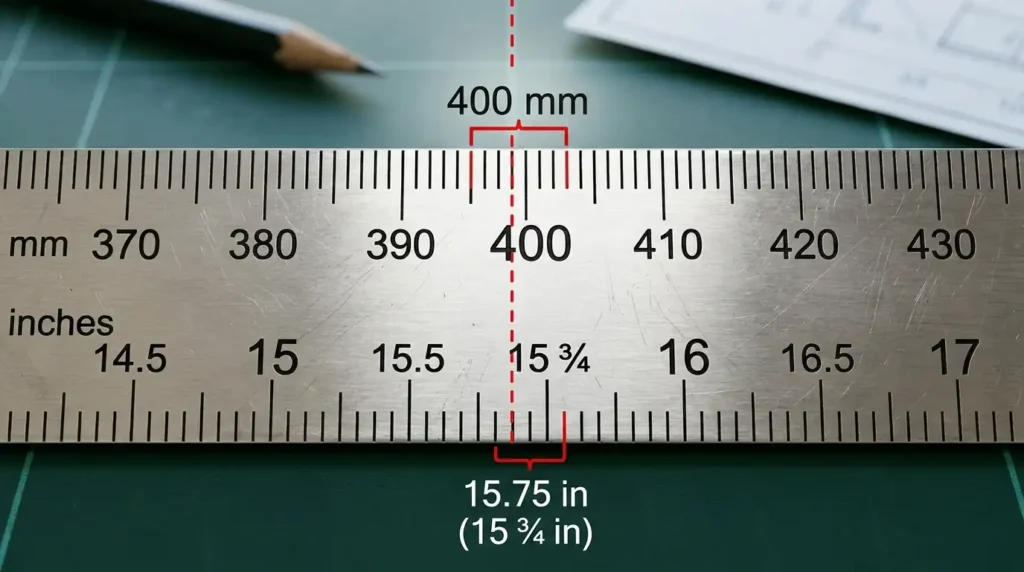
400 mm in inches is 15.75 inches. The full answer is 15.7480314961 inches before rounding. It is also about 1 foot and 3.75 inches.
To change millimeters into inches, divide the number of millimeters by 25.4. For 400 mm, the sum is 400 ÷ 25.4 = 15.7480314961 inches.
This guide shows you how to make this change, how to use the formula, and how to read a quick size chart. It also gives simple examples to help you understand the length.
How to Convert 400 mm to Inches
Changing 400 mm into inches is easy. You only need one simple formula.
Inches = Millimeters ÷ 25.4
Now put 400 into the formula:
400 ÷ 25.4 = 15.7480314961 inches
The answer has many numbers after the decimal point. For daily use, you can round it to two decimal places.
400 mm = 15.75 inches
This is the answer you need when you want to know how many inches are in 400 mm.
Why Do We Divide by 25.4?
Millimeters and inches are two units used to measure length. A millimeter is part of the metric system. An inch is used in the US measuring system and in some other places.
One inch is exactly 25.4 millimeters. This means that one inch is longer than one millimeter.
When you change millimeters into inches, you divide by 25.4. This gives you the same length in inches.
Here are some simple examples:
- 25.4 mm = 1 inch
- 50.8 mm = 2 inches
- 76.2 mm = 3 inches
- 101.6 mm = 4 inches
- 127 mm = 5 inches
The same rule works for 400 mm and other sizes. You do not need a new formula for every number.
Step-by-Step Calculation for 400 mm
Follow these steps to change 400 mm into inches.
Step 1: Write the given length.
The given length is 400 mm.
Step 2: Write the formula.
Inches = Millimeters ÷ 25.4
Step 3: Put 400 into the formula.
Inches = 400 ÷ 25.4
Step 4: Divide the numbers.
400 ÷ 25.4 = 15.7480314961
Step 5: Round the answer.
The answer rounded to two decimal places is 15.75 inches.
So, the final answer is:
400 mm = 15.75 inches (rounded).
You can use these same steps to change any millimeter value into inches.
400 mm in Inches, Feet, and Centimeters
You can write 400 mm in different units. The length stays the same, but the number changes because each unit has a different size.
Here are the main ways to write this length:
| Unit | 400 mm equals |
| Millimeters | 400 mm |
| Centimeters | 40 cm |
| Inches | 15.75 in |
| Feet | 1.31 ft |
| Feet and inches | About 1 ft 3.75 in |
400 mm in Inches
400 mm equals 15.7480314961 inches. When rounded to two decimal places, it becomes 15.75 inches.
This is helpful when you use a ruler or tape that shows inches instead of millimeters.
400 mm in Centimeters
There are 10 millimeters in one centimeter. To change millimeters into centimeters, divide by 10.
400 ÷ 10 = 40 cm
So, 400 mm is exactly 40 cm.
400 mm in Feet
There are 12 inches in one foot. First, change 400 mm into inches. Then divide the answer by 12.
15.7480314961 ÷ 12 = 1.312335958 feet
Rounded to two decimal places, 400 mm is about 1.31 feet.
400 mm in Feet and Inches
Some people find feet and inches easier to read than a number with a decimal point.
The full length is about 15.75 inches. One foot is equal to 12 inches.
Now take 12 inches away from the full length:
15.7480314961 − 12 = 3.7480314961 inches
This gives us:
- 12 inches = 1 foot
- The length left over = about 3.75 inches
So, 400 mm is about 1 foot and 3.75 inches.
Quick Millimeter to Inches Chart
The chart below shows 400 mm and other sizes close to it. You can use it to compare lengths without doing each sum yourself.
| Millimeters (mm) | Inches (in) |
| 360 mm | 14.17 in |
| 370 mm | 14.57 in |
| 380 mm | 14.96 in |
| 390 mm | 15.35 in |
| 400 mm | 15.75 in |
| 410 mm | 16.14 in |
| 420 mm | 16.54 in |
| 430 mm | 16.93 in |
| 440 mm | 17.32 in |
All inch values in this chart are rounded to two decimal places.

How to Read the Chart
Each row shows a length in millimeters and the same length in inches.
For example, 390 mm is about 15.35 inches. The next row shows 400 mm, which is about 15.75 inches. The row after that shows 410 mm, which is about 16.14 inches.
You can use the chart to find a nearby size. If your length is 420 mm, you can see that it is about 16.54 inches.
The chart also shows that the inch value gets bigger when the millimeter value gets bigger.
Is 400 mm Close to 16 Inches?
Yes. 400 mm is close to 16 inches, but the two sizes are not the same.
To find how many millimeters are in 16 inches, multiply 16 by 25.4.
16 × 25.4 = 406.4 mm
Now find the difference:
406.4 − 400 = 6.4 mm
This means 400 mm is 6.4 mm shorter than 16 inches. The difference is about 0.25 inches.
For a quick guess, you can think of 400 mm as close to 16 inches. But if you are cutting wood, fitting a part, or doing careful work, use 15.75 inches instead.
Where Can You Use a 400 mm Measurement?
You may see a 400 mm measurement in many daily tasks. It can be used for home items, building work, tools, and product sizes.
Knowing the inch value can help when one item is measured in millimeters and another is measured in inches.
1. Home Projects
People often measure things at home when they buy furniture, put up shelves, or make small repairs.
A product may show a length of 400 mm on its label. If your tape shows inches, knowing that 400 mm is about 15.75 inches can help you understand its size.
For example, you may need to check if a part will fit into a space. If the space is measured in inches and the part is measured in millimeters, change both sizes into the same unit before you compare them.
Always check the full size of an item before you buy or fit it. A length of 400 mm tells you only one side. It does not tell you the item’s height or width.
2. Building and Repair Work
Millimeters are often used in building and repair work. Workers may use them to measure wood, metal parts, pipes, and other items.
Some tools and tape measures show inches instead. In that case, changing 400 mm into 15.75 inches can help you read the size.
For example, if a plan gives a length of 400 mm but your ruler shows inches, you can use the formula to find the same length in inches.
For careful work, do not use 16 inches instead of 400 mm. The small difference may matter when two parts need to fit together.
3. Shopping for Products
Some online shops show product sizes in millimeters. Other shops use inches. This can make it hard to compare two products.
Changing both sizes into the same unit makes the choice easier.
For example, one product may be listed as 400 mm and another as 15 inches. Since 400 mm is about 15.75 inches, the first product is longer.
Before you buy anything, check whether the number shows the length, width, or height. This can help you choose the right size.
How to Measure 400 mm with an Inch Ruler
If you have a ruler that shows inches, you can use it to find a length close to 400 mm.
Remember that 400 mm is about 15.75 inches. This means the length is between 15 and 16 inches. It is closer to 16 inches.
Follow these steps:
- Place the ruler on a flat surface.
- Find the zero mark at the start of the ruler.
- Measure along the ruler until you reach 15.75 inches.
- Look at the mark between 15 and 16 inches.
- If your ruler does not show hundredths of an inch, use the closest mark it has.
Many rulers show whole inches and smaller marks between them. The number of small marks can be different from one ruler to another.
A ruler may show halves, quarters, eighths, or sixteenths of an inch. A ruler with more small marks can help you measure more closely.
Do not expect every ruler to show 15.75 as a written number. You may need to find the right mark between 15 and 16 inches.
Can You Measure 400 mm with a Centimeter Ruler?
Yes. A centimeter ruler can also help because 400 mm is exactly 40 cm.
If your ruler shows centimeters, look for the 40 cm mark. This is the same length as 400 mm.
This may be easier than using an inch ruler because there are 10 millimeters in one centimeter.
Make sure your ruler is long enough to measure 40 cm. A short ruler may not reach that far in one go. If you use it more than once, keep it straight and line up each new measurement with care.
Common Mistakes When Converting 400 mm to Inches
Changing 400 mm into inches is easy, but a few small mistakes can give you the wrong answer.
Here are some mistakes to watch out for.
Mistake 1: Dividing by 10 Instead of 25.4
Some people divide 400 by 10 and get 40. This answer is correct in centimeters, not inches.
- 400 ÷ 10 = 40 cm
- 400 ÷ 25.4 = 15.7480314961 inches
Always divide by 25.4 when you want to change millimeters into inches.
Mistake 2: Using the Wrong Formula
The formula changes based on which way you are changing the units.
To change millimeters into inches, divide by 25.4.
To change inches into millimeters, multiply by 25.4.
For example, to change 400 mm into inches:
400 ÷ 25.4 = 15.7480314961 inches
To change that full answer back into millimeters:
15.7480314961 × 25.4 = 400 mm
Check which unit you have and which unit you need before you start.

Mistake 3: Saying 15.75 Inches Is Exact
The number 15.75 inches is a rounded answer. The full answer is 15.7480314961 inches.
For normal daily use, 15.75 inches is easy to use. But if you need a very close result, keep more numbers after the decimal point.
Remember that a rounded number is not always the full answer.
Mistake 4: Thinking 400 mm Is Exactly 16 Inches
400 mm is close to 16 inches, but it is not equal to 16 inches.
Sixteen inches equals 406.4 mm. That is 6.4 mm more than 400 mm.
This small gap may matter when you make or fit parts. Use 15.75 inches for the rounded answer instead of writing 16 inches as the exact size.
Mistake 5: Mixing Up Length, Width, and Height
A measurement of 400 mm tells you only one length. It does not give the full size of an item.
For example, a box may have a length of 400 mm, but its width and height may be different. You need all three numbers to know the full size of the box.
Always check which side the number is about.
Why Are Millimeters and Inches Both Used?
Millimeters and inches are both used to measure length, but they belong to different measuring systems.
The metric system uses millimeters, centimeters, and meters. It is based on groups of 10, so changing between these units is easy.
For example:
- 10 mm = 1 cm
- 100 cm = 1 meter
- 1,000 mm = 1 meter
The inch is part of the US measuring system. Twelve inches make one foot, and three feet make one yard.
You may see millimeters on tools, building plans, machine parts, and product labels. You may also see inches on rulers, furniture details, and some product pages.
Knowing how to change between these two systems can help you understand sizes. It also makes it easier to compare products and read plans.
Frequently Asked Questions
1. How many inches are in 400 mm?
400 mm equals 15.7480314961 inches. When rounded to two decimal places, the answer is 15.75 inches.
You can find this answer by dividing 400 by 25.4.
2. Is 400 mm the same as 16 inches?
No. 400 mm is about 15.75 inches, while 16 inches equals 406.4 mm.
The difference is 6.4 mm, or about 0.25 inches. So, 400 mm is a little shorter than 16 inches.
3. How many feet is 400 mm?
400 mm is about 1.31 feet.
You can also write it as about 1 foot and 3.75 inches. Both answers show the same length.
4. How many centimeters are in 400 mm?
400 mm equals exactly 40 cm.
To change millimeters into centimeters, divide by 10:
400 ÷ 10 = 40 cm
5. What is the formula for changing millimeters into inches?
The formula is:
Inches = Millimeters ÷ 25.4
For 400 mm, the sum is:
400 ÷ 25.4 = 15.7480314961 inches
You can use this formula for any millimeter value.
6. How do I change 15.75 inches back into millimeters?
To change inches into millimeters, multiply by 25.4.
15.75 × 25.4 = 400.05 mm
This answer is a little more than 400 mm because 15.75 inches is rounded. If you use the full value of 15.7480314961 inches, the answer is 400 mm.
7. Is 400 mm a long measurement?
That depends on what you are measuring. It is 40 cm or about 15.75 inches.
It is longer than one foot but shorter than one and a half feet. You can use a ruler or tape measure to get a better idea of its size.
8. Can I use 16 inches instead of 400 mm?
For a quick guess, 16 inches is close to 400 mm. But the two sizes are not equal.
If you are doing careful work, use 15.75 inches or the full value of 15.7480314961 inches. This is helpful when parts need to fit or when you are cutting something to the right size.
Conclusion
400 mm in inches equals 15.75 inches when rounded to two decimal places. The full answer is 15.7480314961 inches. It is also 40 cm, about 1.31 feet, or about 1 foot and 3.75 inches.
The easiest way to make this change is to divide 400 by 25.4. You can use the same formula for other millimeter values. The chart in this guide can also help you check nearby sizes.
When you measure something, always use the right unit and check your answer before cutting or fitting it. Remember that 400 mm is close to 16 inches, but it is not exactly 16 inches.

Chloe Harper writes clear, practical guides on measurements and unit conversions. She focuses on simple explanations and real-life examples so readers can get accurate answers quickly.