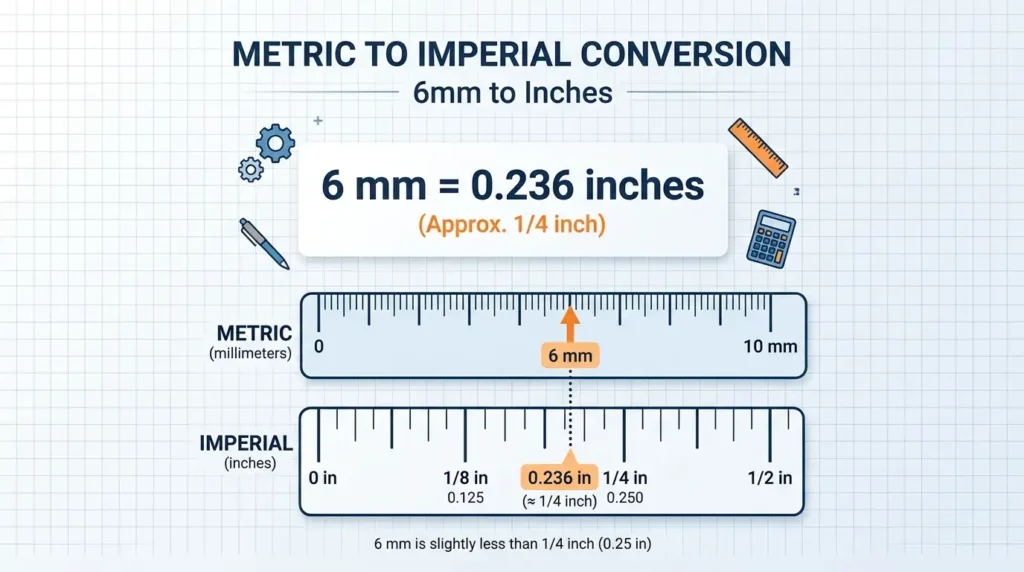
6 mm = 0.2362 inches (approximately).
If you want to convert 6 millimeters to inches, divide 6 by 25.4. The result is 0.23622047 inches. As a fraction, 6 mm is approximately 15/64 inches, which is slightly less than 1/4 inch.
This conversion is useful when measuring tools, choosing drill bits, checking hardware sizes, or comparing metric measurements with standard US inch measurements.

6 mm to Inches Conversion
Here is the quick conversion for 6 millimeters:
6 millimeters in inches
0.2362 inches
Exact decimal (rounded)
0.23622047 in
Closest 1/64 fraction
15/64 in
Compared with 1/4 inch
Slightly smaller
Remember that 6 mm is not exactly 1/4 inch. A quarter inch equals 6.35 mm, so the difference is 0.35 mm.
How to Convert 6mm to Inches
You can convert millimeters into inches with one simple formula:
Inches=Millimeters25.4
One inch contains exactly 25.4 millimeters. Therefore, divide any millimeter measurement by 25.4 to get its equivalent in inches.
For 6 mm, the calculation looks like this:
625.4=0.2362204724
So:
\[ \boxed{6\text{ mm}=0.2362\text{ inches}} \]
You can use the same formula for other measurements. For example, if you have a 10 mm measurement, divide 10 by 25.4 to find its inch equivalent.
What Is 6mm in Inches as a Fraction?
If you work with rulers, woodworking tools, or hardware, you may prefer fractional inches instead of decimal measurements.
The decimal equivalent of 6 mm is 0.23622047 inches.
The closest fraction when using sixty-fourths of an inch is:
1564=0.234375
This makes 15/64 inch a useful fractional approximation for 6 mm.
Here is a comparison of nearby fractional measurements:
| Fraction | Decimal inches | Difference from 6 mm |
| 7/32 | 0.21875 | 0.01747 |
| 15/64 | 0.234375 | 0.00185 |
| 1/4 | 0.25000 | 0.01378 |
| 17/64 | 0.265625 | 0.02940 |
| 9/32 | 0.28125 | 0.04503 |
The 15/64-inch fraction is closer to 6 mm than 1/4 inch when comparing these common 1/64-inch increments.
However, the decimal measurement is more precise than the fractional approximation.
Is 6mm Equal to 1/4 Inch?
No. A 6 mm measurement is slightly smaller than 1/4 inch.
Here is the difference:
- 6 mm = 0.2362 inches
- 1/4 inch = 0.2500 inches
- Difference = 0.0138 inches
In metric measurements, 1/4 inch equals 6.35 mm. This means a quarter-inch measurement is 0.35 mm larger than 6 mm.
The difference may look small, but it can matter when working with machine parts, drill bits, fittings, and other items that need accurate measurements.
If you are comparing these two sizes, remember that they are close but not identical.
How Big Is 6mm on a Ruler?
A 6 mm measurement is a little less than 1/4 inch on a standard inch ruler.
To find 6 mm on a ruler, look between the 3/16-inch and 1/4-inch marks. The measurement falls closer to the 1/4-inch mark.
Here is how the nearby measurements compare:
- 3/16 inch = 4.7625 mm
- 15/64 inch = 5.9531 mm
- 6 mm = 0.2362 inches
- 1/4 inch = 6.35 mm
If your ruler has 1/64-inch markings, 15/64 inch is the closest fractional mark to 6 mm.
A standard ruler may not show the exact decimal value. For more accurate work, use a digital caliper or a metric ruler with millimeter markings.

What Is a 6mm Drill Bit in Inches?
A 6 mm drill bit has a diameter of approximately 0.2362 inches.
If you are looking for its closest fractional inch equivalent, 15/64 inch is the nearest common 1/64-inch size.
Here is a simple comparison:
| Drill bit size | Diameter in inches |
| 5 mm | 0.1969 in |
| 5.5 mm | 0.2165 in |
| 6 mm | 0.2362 in |
| 6.35 mm | 0.2500 in |
| 6.5 mm | 0.2559 in |
Is a 1/4-inch drill bit the same as a 6 mm drill bit?
No. A 1/4-inch drill bit measures 6.35 mm, while a 6 mm drill bit measures approximately 0.2362 inches.
A 1/4-inch drill bit is slightly larger. Choosing between them depends on the material, hole size, fastener, and required fit.
For precision work, use the specified drill bit size rather than assuming that two close measurements are interchangeable.
Millimeters to Inches Conversion Chart
The following chart shows several nearby millimeter measurements and their decimal and fractional inch equivalents.
| Millimeters (mm) | Decimal inches | Closest 1/64 fraction |
| 1 mm | 0.0394 | 3/64 |
| 2 mm | 0.0787 | 5/64 |
| 3 mm | 0.1181 | 8/64 |
| 4 mm | 0.1575 | 10/64 |
| 5 mm | 0.1969 | 13/64 |
| 6 mm | 0.2362 | 15/64 |
| 7 mm | 0.2756 | 18/64 |
| 8 mm | 0.3150 | 20/64 |
| 9 mm | 0.3543 | 23/64 |
| 10 mm | 0.3937 | 25/64 |
| 12 mm | 0.4724 | 30/64 |
| 16 mm | 0.6299 | 40/64 |
| 20 mm | 0.7874 | 50/64 |
Note: Fractional values are rounded to the nearest 1/64 inch. They are approximations, not exact equivalents.
How to Convert Any Millimeter Measurement to Inches
You do not need a special calculator to convert millimeters into inches. You only need to know the conversion factor.
Use this formula:
Inches=Millimeters25.4
Follow these three steps:
- Find the measurement in millimeters.
- Divide that number by 25.4.
- Write the result in inches.
For example, if you want to convert 10 mm to inches:
1025.4=0.3937007874
Therefore, 10 mm equals approximately 0.3937 inches.
You can use this method for small measurements, large measurements, and decimal millimeter values.
To convert inches back into millimeters, simply multiply the inch measurement by 25.4.
Common Mistakes When Converting 6mm to Inches
A few common mistakes can lead to incorrect measurements.
1. Treating 6 mm as exactly 1/4 inch
These measurements are close, but they are not equal. Six millimeters equals 0.2362 inches, while 1/4 inch equals 0.25 inches.
2. Multiplying instead of dividing
When converting millimeters to inches, divide by 25.4. Multiplying by 25.4 converts inches into millimeters.
3. Rounding too early
If you need an accurate measurement, keep several decimal places during the calculation. Round the final answer only when necessary.
4. Confusing decimal and fractional inches
A decimal measurement such as 0.2362 inches is not the same as 1/4 inch. The closest 1/64-inch fraction for 6 mm is 15/64 inch.

Frequently Asked Questions
1. How many inches is 6 mm?
Six millimeters equals approximately 0.2362 inches. You can calculate this by dividing 6 by 25.4.
2. What is 6 mm in inches as a fraction?
Six millimeters is approximately 15/64 inch when rounded to the nearest 1/64-inch fraction.
3. Is 6 mm the same as 1/4 inch?
No. Six millimeters equals 0.2362 inches, while 1/4 inch equals 6.35 mm. Therefore, 1/4 inch is slightly larger.
4. What is 6 mm on a standard ruler?
Six millimeters falls slightly below the 1/4-inch mark. Its closest 1/64-inch ruler marking is 15/64 inch.
5. What size is a 6 mm drill bit in inches?
A 6 mm drill bit measures approximately 0.2362 inches in diameter. Its closest common 1/64-inch fractional size is 15/64 inch.
6. How do you convert 6 mm to decimal inches?
Divide 6 by 25.4. The result is 0.2362204724 inches, or approximately 0.2362 inches.
7. Is 6 mm closer to 3/16 or 1/4 inch?
Six millimeters is closer to 1/4 inch than 3/16 inch. However, its closest 1/64-inch fraction is 15/64 inch.
8. How do you convert inches back to millimeters?
Multiply the inch measurement by 25.4. For example, 0.2362 inches multiplied by 25.4 gives approximately 6 mm.
Final Answer
To convert 6 mm to inches, divide 6 by 25.4. The result is 0.23622047 inches, or approximately 0.2362 inches.
If you need a fractional measurement, use 15/64 inch as the closest 1/64-inch approximation. Although 6 mm is close to 1/4 inch, it is slightly smaller.
For accurate measurements, use the decimal conversion instead of treating the fractional approximation as an exact value.

Chloe Harper writes clear, practical guides on measurements and unit conversions. She focuses on simple explanations and real-life examples so readers can get accurate answers quickly.