

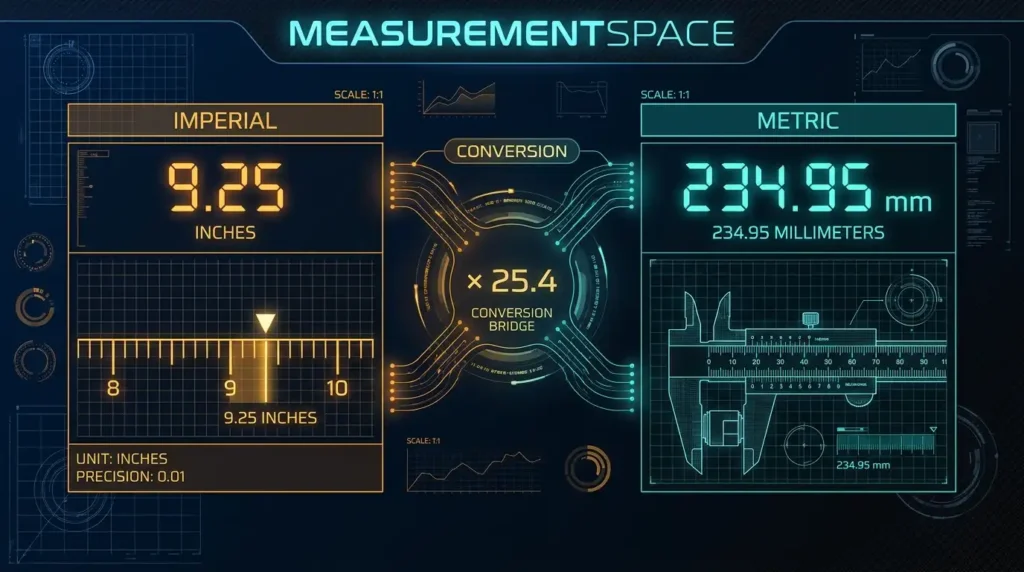
9.25 inches is exactly 234.95 millimeters (mm). To convert inches to millimeters, multiply the inch value by 25.4. So, 9.25 × 25.4 = 234.95 mm.
If you need this measurement for a ruler, DIY project, furniture, schoolwork, or another task, this guide explains the conversion in simple words.
How Many Millimeters Are in 9.25 Inches?
There are 234.95 millimeters in 9.25 inches.
Here is the full conversion:
- Inches: 9.25
- Millimeters: 234.95 mm
- Centimeters: 23.495 cm
The result is exact because one inch is always equal to 25.4 millimeters.
You can write the answer in different ways depending on how much detail you need:
- Exact answer: 234.95 mm
- Rounded to the nearest whole millimeter: 235 mm
- Rounded to one decimal place: 235.0 mm
For most tasks, 234.95 mm is the best answer because it keeps the full conversion result.
How to Convert 9.25 Inches to Millimeters
Converting inches to millimeters is simple. You only need to know one number: 25.4.
One inch equals 25.4 millimeters. This number is fixed, so you can use it for any inch-to-mm conversion.
The Conversion Formula
Use this formula:
Millimeters = Inches × 25.4
For the value 9.25 inches, place 9.25 into the formula:
9.25 × 25.4 = 234.95
Therefore:
9.25 inches = 234.95 mm
You can use the same formula for small and large measurements. Just multiply the number of inches by 25.4.
Step-by-Step Calculation
Follow these easy steps to convert 9.25 inches to mm.
Step 1: Write the inch value.
Start with the given measurement:
9.25 inches
Step 2: Write the conversion number.
One inch is equal to 25.4 millimeters.
Step 3: Multiply the two numbers.
9.25 × 25.4
Step 4: Complete the calculation.
9.25 × 25.4 = 234.95
Step 5: Add the correct unit.
The final answer is 234.95 mm.
This is the complete conversion. You do not need to divide by 25.4 when changing inches into millimeters.
Why Do We Multiply by 25.4?
Inches and millimeters are two different units used to measure length.
An inch is part of the imperial measurement system. Millimeters are part of the metric system.
A millimeter is much smaller than an inch. One inch contains 25.4 millimeters. This means the number becomes larger when you change inches into millimeters.
For example:
- 1 inch = 25.4 mm
- 2 inches = 50.8 mm
- 3 inches = 76.2 mm
- 4 inches = 101.6 mm
The same rule applies to 9.25 inches. Since one inch contains 25.4 millimeters, multiply 9.25 by 25.4.
This gives 234.95 mm.
Remember this simple rule:
- Inches to millimeters: multiply by 25.4.
- Millimeters to inches: divide by 25.4.
Knowing these two rules makes it easier to move between the two units.
9.25 Inches to mm, cm, and Other Units
You may need to use 9.25 inches in more than one measurement system. Here are some useful conversions.
| Measurement unit | Converted value |
| Inches | 9.25 in |
| Millimeters | 234.95 mm |
| Centimeters | 23.495 cm |
| Meters | 0.23495 m |
| Feet | 0.770833 ft |
The most common result is 234.95 mm.
Convert 9.25 Inches to Centimeters
To change inches into centimeters, multiply the inch value by 2.54.
Formula:
Centimeters = Inches × 2.54
Now use 9.25:
9.25 × 2.54 = 23.495
So:
9.25 inches = 23.495 cm
There are 10 millimeters in one centimeter. You can also check the result by dividing 234.95 mm by 10.
234.95 ÷ 10 = 23.495 cm
Both methods give the same answer.
Convert 9.25 Inches to Meters
A meter contains 100 centimeters or 1,000 millimeters.
To convert millimeters into meters, divide by 1,000.
234.95 ÷ 1,000 = 0.23495
Therefore:
9.25 inches = 0.23495 meters
This unit is useful when measuring larger spaces or comparing lengths in meters.
Convert 9.25 Inches to Feet
There are 12 inches in one foot.
To change inches into feet, divide by 12.
9.25 ÷ 12 = 0.7708333…
So:
9.25 inches is about 0.7708 feet.
You can also write it as 9.25 inches, or 9¼ inches. This is often easier to understand when using a ruler.
Quick Conversion Chart for Inches to Millimeters
A conversion chart helps you find answers without doing the calculation every time.
The following chart includes measurements close to 9.25 inches.
| Inches | Millimeters | Centimeters |
| 8.25 in | 209.55 mm | 20.955 cm |
| 8.50 in | 215.90 mm | 21.590 cm |
| 8.75 in | 222.25 mm | 22.225 cm |
| 9.00 in | 228.60 mm | 22.860 cm |
| 9.25 in | 234.95 mm | 23.495 cm |
| 9.50 in | 241.30 mm | 24.130 cm |
| 9.75 in | 247.65 mm | 24.765 cm |
| 10.00 in | 254.00 mm | 25.400 cm |
| 10.25 in | 260.35 mm | 26.035 cm |
This chart is helpful when you need a nearby measurement. For example, if you want to compare 9 inches with 9.25 inches, you can see that the difference is 6.35 mm.

What Does 9.25 Inches Look Like on a Ruler?
A ruler can help you understand this measurement.
The value 9.25 inches is the same as 9¼ inches. This means it is 9 inches plus one-quarter of another inch.
On a ruler:
- Find the 9-inch mark.
- Look at the space between 9 and 10 inches.
- Divide that space into four equal parts.
- The first quarter-inch mark after 9 is 9.25 inches.
The same length is 234.95 mm.
If you use a metric ruler, look for the 234.95 mm point. It is just a little less than 235 mm.
Is 9.25 Inches the Same as 9¼ Inches?
Yes. The decimal number 9.25 is equal to the fraction 9¼.
Here is why:
0.25 = ¼
So:
9.25 = 9 + 0.25 = 9¼
Both forms describe the same length.
You may see decimal inches on digital tools and product details. You may see fractions on tape measures and workshop rulers. Knowing both forms makes measurement easier.
Is 234.95 mm the Same as 235 mm?
Not exactly.
The exact result is 234.95 mm. When rounded to the nearest whole millimeter, it becomes 235 mm.
The difference is:
235 − 234.95 = 0.05 mm
This is a very small difference, but it can matter in tasks that need exact measurements.
Use 234.95 mm when accuracy is important. Use 235 mm when a whole-number estimate is enough.
For example, a general size description may use 235 mm. A technical drawing or a measurement record may need 234.95 mm.
Always check the level of accuracy required for your task before rounding.
Where Can You Use a Measurement of 9.25 Inches?
A length of 9.25 inches, or 234.95 mm, can be used in many everyday and work-related tasks.
The best unit depends on the job. Some people prefer inches, while others use millimeters.
1. Home Projects
You may need to measure a part of a shelf, a board, a small table, or another item around your home.
If a plan gives a length of 9.25 inches, you can use 234.95 mm when working with metric tools.
For example, a person using a metric ruler can mark a point close to 235 mm.
For a precise cut, use the exact measurement and check the tool’s accuracy before cutting.
2. Woodworking
Woodworkers often use both inches and millimeters.
A plan may give a measurement in inches, while a ruler or cutting tool uses millimeters.
Changing 9.25 inches into 234.95 mm helps you follow the plan without changing the intended length.
Always check the thickness and width of the material as well. A correct length alone does not make a full measurement.
3. School and Study Work
Students may need to convert inches into millimeters in math and science lessons.
The 9.25-inch example is useful for learning multiplication and unit conversion.
The steps are simple:
- Write the inch value.
- Multiply it by 25.4.
- Add the unit mm.
- Check the answer.
This method works for other inch values too.
4. Product Measurements
Some product details use inches, while others use millimeters.
You may find a product size listed as 9.25 inches. If you are more familiar with metric units, the value 234.95 mm is easier to compare with other measurements.
Check whether the listed number refers to length, width, height, or another part of the product. The unit alone does not tell you which side is being measured.
5. Craft and DIY Work
Craft projects often need careful measurements.
For example, you may need to cut paper, fabric, plastic, or another material to a set length.
If the instruction says 9.25 inches, the metric value is 234.95 mm.
For simple work, 235 mm may be close enough. For work that needs a close fit, use the exact value and the right measuring tool.
6. Technical Drawings
Technical drawings may use either metric or imperial units.
If a drawing gives a length in inches and your measuring tool uses millimeters, you can convert the value using the standard formula.
For 9.25 inches, the result is 234.95 mm.
Do not change the value without checking the drawing’s rules. Some technical work requires exact values, while other work allows a stated tolerance.
Common Mistakes When Converting Inches to Millimeters
The conversion is easy, but a few mistakes can lead to the wrong answer.
Mistake 1: Dividing Instead of Multiplying
When converting inches to millimeters, you must multiply by 25.4.
Wrong method:
9.25 ÷ 25.4
Correct method:
9.25 × 25.4 = 234.95 mm
Division is used when you are changing millimeters into inches.
Mistake 2: Using the Wrong Conversion Number
Some people use 25 or 25.5 instead of 25.4.
These numbers may give a close estimate, but they do not give the exact standard conversion.
Always use 25.4 for inches to millimeters.
Mistake 3: Forgetting the Unit
A number by itself may not explain the measurement.
Write 234.95 mm instead of only writing 234.95.
This makes it clear that the result is in millimeters.
Mistake 4: Rounding Too Early
If you round 9.25 inches or the conversion number before doing the calculation, the result may change.
Keep the original values during the calculation. Round only at the end if your task needs it.
Mistake 5: Mixing Up Millimeters and Centimeters
Millimeters and centimeters are not the same unit.
One centimeter contains 10 millimeters.
So, 234.95 mm equals 23.495 cm, not 234.95 cm.
Check the unit before writing your final answer.

How to Check Your Conversion
You can check the answer by changing millimeters back into inches.
The formula is:
Inches = Millimeters ÷ 25.4
Use the result from the first calculation:
234.95 ÷ 25.4 = 9.25
You get the original value again.
This shows that the conversion is correct.
You can also check the answer using centimeters:
23.495 cm × 10 = 234.95 mm
Both checks give the same result.
Checking your work is useful when you are completing a school question, measuring material, or following a plan.
Easy Way to Remember the Conversion
You do not need to learn a new number for every measurement.
Just remember these two facts:
- 1 inch = 25.4 mm
- 1 cm = 10 mm
For inches to millimeters, multiply by 25.4.
For millimeters to inches, divide by 25.4.
You can use a calculator for long numbers, but it is still useful to know the formula. It helps you understand why the answer changes and lets you check the result.
Frequently Asked Questions
1. How many mm is 9.25 inches?
9.25 inches is exactly 234.95 mm. Multiply 9.25 by 25.4 to get the answer.
2. What is 9.25 inches in cm?
9.25 inches equals 23.495 cm. To convert inches into centimeters, multiply 9.25 by 2.54.
3. Is 9.25 inches the same as 9¼ inches?
Yes. 9.25 inches and 9¼ inches are two ways to write the same measurement. The decimal 0.25 is equal to one-quarter.
4. How do I convert 9.25 inches to mm without a chart?
Use the formula: millimeters = inches × 25.4. Multiply 9.25 by 25.4. The answer is 234.95 mm.
5. Should I write 234.95 mm or 235 mm?
Use 234.95 mm when you need the exact conversion. Use 235 mm when rounding to the nearest whole millimeter is acceptable.
6. Is 9.25 inches more than 200 mm?
Yes. 9.25 inches equals 234.95 mm, which is 34.95 mm more than 200 mm.
7. How many centimeters are in 234.95 mm?
There are 23.495 centimeters in 234.95 millimeters. Divide the millimeter value by 10 to get centimeters.
8. What is the easiest formula for inches to mm?
The easiest formula is:
mm = inches × 25.4
Use this formula for any inch measurement.
Final Answer: 9.25 Inches to mm
The exact conversion of 9.25 inches to mm is 234.95 mm.
To find this answer, multiply 9.25 by 25.4. You can use the same method for any measurement in inches.
You can also write 9.25 inches as 9¼ inches or 23.495 centimeters. If you only need a whole-number estimate, the value rounds to 235 mm.

Chloe Harper writes clear, practical guides on measurements and unit conversions. She focuses on simple explanations and real-life examples so readers can get accurate answers quickly.
